

The plane descends through cloud. You have been flying for ten hours from London or Dubai or Doha, and the last hour has been over the brown plains of northern India, featureless and flat. Then the terrain changes. Hills appear. The hills grow into mountains. The mountains grow into the Himalayas, and somewhere below them, in a valley ringed by terraced slopes and ancient temples, Kathmandu waits.
Tribhuvan International Airport is not a large airport. It has one international terminal, one domestic terminal, and one runway that handles everything from wide-body jets to the tiny twin-otters that fly to Lukla. The terminal building is functional rather than impressive. The signage is adequate rather than intuitive. And the immigration hall, at peak arrival times, is an experience in patience that prepares you well for the pace of life in Nepal.
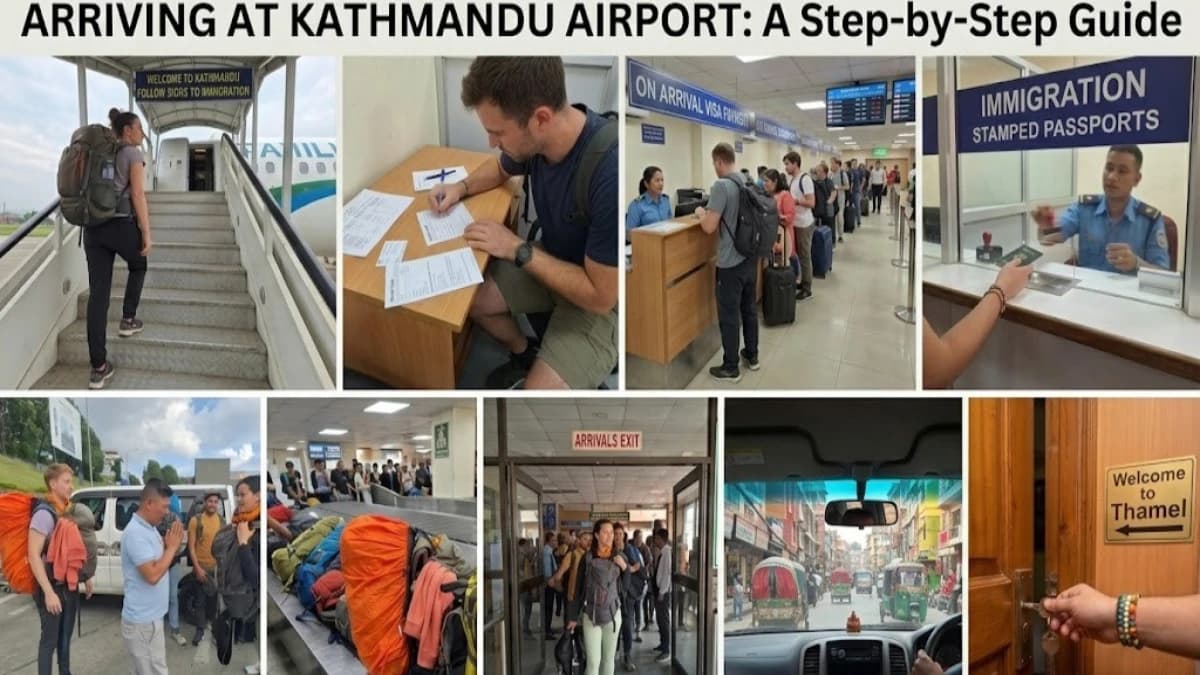
Here is what happens, step by step, from the moment you unbuckle your seatbelt to the moment you collapse on a hotel bed in Thamel and wonder whether the mountains you glimpsed from the taxi window were real or a hallucination produced by jet lag.
Step 1: Leave the Aircraft and Follow the Signs
You walk from the plane through a corridor into the arrivals hall. There is one direction to go, follow the other passengers. The terminal is small enough that getting lost requires genuine effort.
Do you need to fill in an arrival card for Nepal?
At the entrance to the immigration hall, banks of touchscreen kiosks await. They are self-explanatory: enter your name, passport number, nationality, flight number, address in Nepal (your hotel name is sufficient), and purpose of visit (tourism). The machine takes your photograph through a small camera. The process takes two to three minutes.
If the kiosks are busy or malfunctioning, both happen, paper arrival forms are available from a desk nearby. Fill them in with the pen you brought (always carry a pen on international flights) or borrow one from a fellow passenger.
The shortcut: fill in the online arrival form before your flight at Nepal's immigration portal. You receive a QR code. At the airport, scan the code at a kiosk instead of filling in the form. This skips the data entry queue and saves ten to fifteen minutes.
How much does a Nepal visa on arrival cost?
Join the visa payment queue. This is typically the longest wait in the process, fifteen to forty-five minutes depending on how many flights have landed simultaneously. You hand your passport and completed arrival card to a counter officer. You pay the visa fee in cash: thirty dollars for fifteen days, fifty dollars for thirty days, or one hundred and twenty-five dollars for ninety days.
US dollars are the fastest currency to process. Euros, pounds, and Australian dollars are also accepted. Credit cards are not accepted for visa payment. Having exact change, a fifty-dollar bill for the thirty-day visa, eliminates the wait for the officer to find change from a drawer that may or may not contain the right denominations.
You receive a payment receipt. Keep it. You need it for the next step.
What happens at immigration at Kathmandu airport?
Join the immigration queue with your passport and payment receipt. An officer photographs you through a desk-mounted camera, stamps your visa into your passport, and waves you through. This step is usually faster than the payment queue, five to fifteen minutes.
Total time from plane door to cleared immigration: thirty minutes on a quiet morning. Sixty to ninety minutes on a busy evening when three Gulf carrier flights land within an hour of each other.
How long does baggage claim take at Kathmandu airport?
Kathmandu airport has one baggage carousel for international arrivals. It works. It is not fast. Your bag may take ten to thirty minutes to appear. If your flight was full, the carousel becomes crowded with passengers and bags in a way that tests your personal space boundaries and your ability to spot your luggage in a rotating pile of similar-looking duffel bags.
If your bag does not appear: the lost luggage counter is staffed and functional. File a report immediately. Most bags arrive on the next available flight from your connection airport. The airline will deliver it to your hotel at no charge. This is rare but it happens, which is why carrying one change of clothes, your medications, and your essential documents in your hand luggage is always advisable.
Step 6: Exit to the Arrivals Hall
Walk through the green channel, "nothing to declare", and push through the doors into the arrivals hall. The temperature changes. The sound changes. The smell changes. You are in Nepal.
The arrivals hall is crowded with drivers holding name signs, hotel touts offering transport, money changers quoting rates, and SIM card vendors from Ncell and NTC calling from their counters. It is overwhelming if you are not expecting it. It is perfectly navigable if you are.
How do you get a taxi or driver at Kathmandu airport?
If you booked with a trekking company, your driver is waiting with a sign showing your name. Look for it. If you do not see it, wait five minutes, drivers sometimes cannot access the hall until the crowd thins. If after ten minutes there is still no sign, call the company on your phone (this is where having bought a SIM card inside the terminal pays off) or use the airport WiFi to message them on WhatsApp.
If you did not arrange a pickup, prepaid taxi counters inside the arrivals hall offer fixed-rate rides to Thamel and other tourist areas. The fixed rate eliminates negotiation, you pay at the counter, receive a receipt, and hand it to the assigned driver. As of 2026, the prepaid taxi to Thamel costs approximately seven hundred to one thousand Nepali rupees, five to eight dollars.
How long is the drive from Kathmandu airport to Thamel?
Twenty to forty minutes depending on traffic. Kathmandu traffic is a force of nature, motorcycles, taxis, buses, trucks, pedestrians, dogs, and occasionally a cow share the road in a fluid negotiation that operates on rules visible only to those who grew up in them. Your driver navigates this with the calm of someone who has done it ten thousand times. Your job is to sit in the back seat and try not to grip the door handle too visibly.
The drive gives you your first impressions of Kathmandu, narrow streets, colourful shop fronts, temple spires above the rooftops, power lines crossing the sky in every direction, and the ever-present background of car horns that is not aggression but communication. The city is chaotic and beautiful in equal measure, and the chaos diminishes as you learn to see the order within it.
Step 9: Your Hotel
Check in. Drop your bags. Shower. And then, if you have any energy remaining after ten hours of flying and ninety minutes of airport, step outside. Walk to the nearest intersection. Look up. On a clear day, through the gaps between buildings and above the tangle of power lines, you can see them: the white peaks of the Himalayas, impossibly high, impossibly close, waiting.
You have arrived. Tomorrow, or the day after, you start walking toward them.
How Do You Get Through Kathmandu Airport Quickly?
Fill in the online arrival form before your flight. Carry exact change in US dollars for the visa. Buy a Nepali SIM card from the Ncell or NTC counter in the arrivals hall before exiting, it takes five minutes and gives you immediate phone and data access. Have your hotel name and address saved on your phone, the driver may ask. Carry a pen. Carry patience. And carry the understanding that Kathmandu airport is not Heathrow or Changi, it is a gateway to the Himalayas that functions on its own terms, at its own pace, and with its own particular brand of organised chaos that somehow, reliably, gets everyone where they need to go.
See our Nepal treks for full arrival info. Airport pickup is included in every package.
Kathmandu airport is chaotic and wonderful in equal measure. The visa queue, the baggage carousel, the taxi drivers outside: it is a sensory overload after a long flight. But if you know what to expect, it takes thirty minutes from landing to hotel transfer. Fill in the visa form online before you fly, have USD cash ready for the fee, and your guide will be waiting outside arrivals with a sign. It is that simple.
We include airport pickup on every package. Your guide meets you at arrivals.
Long-stay travellers, including digital nomads working from Nepal, sometimes need second-day extensions on entry.
WhatsApp:+977 9810351300
Email:[email protected]
Written by Shreejan Simkhada, CEO of The Everest Holiday and third-generation Himalayan guide. TAAN Member #1586.
Arrival airport pickup: included in our city tour. Our Kathmandu & Pokhara Tour (7 Days) is private (your group only, no strangers), 2026 dates open, From USD $749. WhatsApp us for tailored 2026 dates and current departures.

 Chat with Shreejan