

Last updated 2 October 2026. The distances below come from our live 9-day Annapurna Base Camp itinerary. The 5-day and 7-day versions from Pokhara are covered below. The trails were reported open on 29 September, with one road problem on the way to the trailhead, set out in the status section.
The short answer: on our 9-day itinerary you walk roughly 55 to 68 km on days 3 to 8, after a short first walk to Ghandruk, up to Annapurna Base Camp at 4,130 m and back down to Jhinu Danda and Nayapul. Many guides quote about 110 km over ten days, which is a different route by Ghorepani. The range is wide because our itinerary prints a range of kilometres for most days, not one figure.
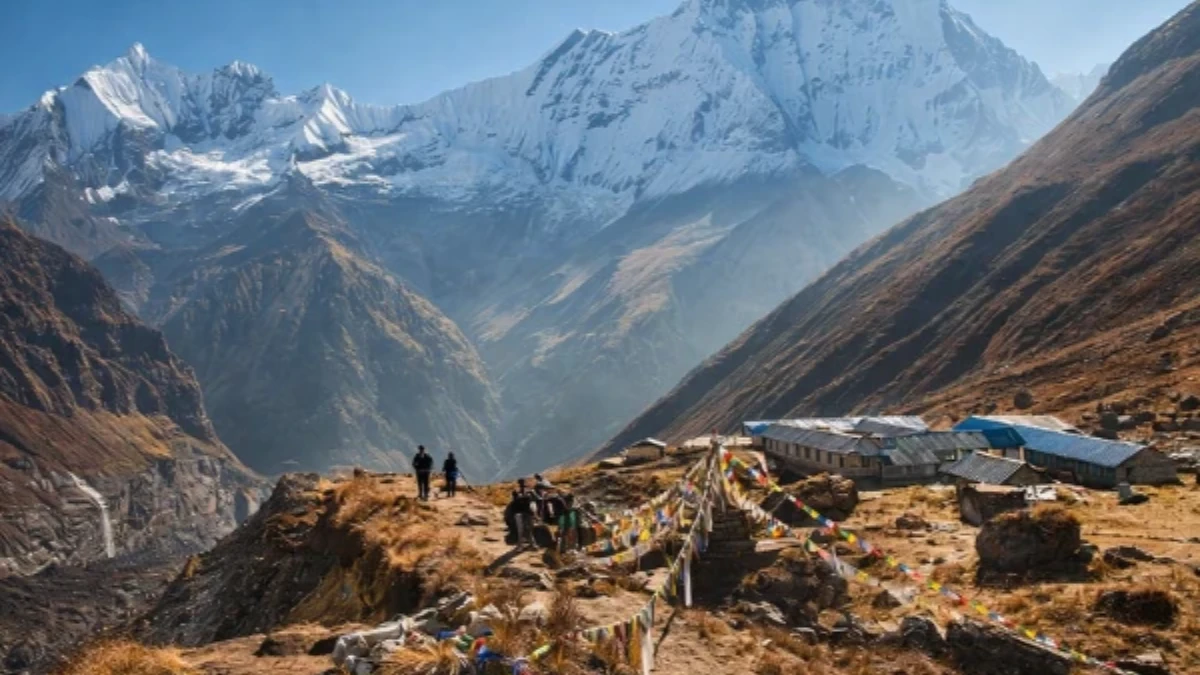
How far do you walk each day on the Annapurna Base Camp trek?
This is the plan from our live itinerary. Distances, altitudes and times are the figures printed on it, so treat them as approximate. Day 2 prints a time but no distance.
| Day | Route | Sleep | Distance | Time |
|---|---|---|---|---|
| 1 | Drive Kathmandu to Pokhara | Hotel in Pokhara, 820 m | 200 km by road | 7 to 8 hours |
| 2 | Drive to Nayapul, trek to Ghandruk | Teahouse, 1,940 m | No distance printed | 3 hours walking |
| 3 | Ghandruk to Chomrong | Teahouse, 2,170 m | 10 to 13 km | 4 hours |
| 4 | Chomrong to Deurali | Teahouse, 3,174 m | 10 to 12 km | 7 hours |
| 5 | Deurali to Annapurna Base Camp, via Machhapuchhre Base Camp | Teahouse, 4,130 m | 7 to 8 km | 2 to 3 hours |
| 6 | Annapurna Base Camp to Bamboo | Teahouse, 2,310 m | 15 to 19 km | 6 hours |
| 7 | Bamboo to Jhinu Danda | Teahouse, 1,780 m | 8.5 to 11.7 km | 4 hours |
| 8 | Jhinu Danda to Nayapul, drive to Pokhara | Hotel in Pokhara, 820 m | 4 km (as printed) | 4 hours |
| 9 | Drive Pokhara to Kathmandu | 210 km by road | 7 to 8 hours |
Adding the printed ranges for days 3 to 8 gives about 54.5 to 67.7 km. Two honest notes. First, day 2 has no printed distance, so the walk to Ghandruk is not in that total. Second, day 8 prints only 4 km for four hours, which looks short for the walk down from Jhinu Danda to the road, so it may be understated. Until our guides confirm it, use the range as an order of magnitude, not a measurement. The days on the road are the part we can state exactly: 200 km out and 210 km back.
Why does this differ from the 110 km you may have seen?
Many guides describe a route from Nayapul by Ghorepani and Poon Hill, with ten walking days and about 110 km. Our 9-day itinerary goes up through Ghandruk and Chomrong instead and comes back down the same valley to Jhinu Danda and Nayapul, so it is shorter on foot. Neither number is wrong. They describe different routes, so when you compare operators, ask for the day-by-day plan and not the headline figure. If you want Ghorepani and Poon Hill, that is our 6-day Poon Hill trek.
Is there a 5-day or 7-day version of the Annapurna Base Camp trek?
Yes, we run both, from Pokhara. The 7-day trek walks the same route as the 9-day without the two road days to and from Kathmandu: a 90-minute drive to Nayapul and 3 hours on foot to Ghandruk on day 1, then the same days up to ABC and back to Nayapul. It is from US$605 Budget, US$1,045 Standard and US$2,045 Luxury for one traveller. The 5-day trek takes a 4WD jeep from Pokhara to Jhinu Danda on day 1 and sleeps at Chomrong, so there is no easy first day and you gain height fast. It is for fit trekkers who have already been above 3,500 m, it does not run from June to September, and it is from US$480, US$790 and US$1,470. The climb from Chomrong to Deurali and then to 4,130 m is where altitude catches people on all three, so choose by how much time and acclimatisation you have, not by price. Our guide to choosing between the 5, 7 and 9-day versions sets them side by side. If you have even less time, the 6-day Poon Hill trek, which peaks at 3,210 m, and the 7-day Mardi Himal trek do not go to ABC.
Which day is the hardest?
Day 4 is the longest in time: 10 to 12 km and about 7 hours from Chomrong to Deurali, climbing from 2,170 m to 3,174 m. Day 5 is the short one by distance, 7 to 8 km, but it takes you to 4,130 m, where the air is noticeably thin, and the walk is only 2 to 3 hours so that you can arrive early and rest. Day 6 is the longest in distance: 15 to 19 km and about 6 hours from ABC to Bamboo, with a descent of about 1,800 m. Your knees will notice it more than your lungs.
Our guides carry a pulse oximeter on every trek so they can check your oxygen saturation. It is a guide, not a diagnosis, and the guide's judgement comes first. If you feel unwell at Deurali, the answer is to stay or go down, not to push on.
Is the Annapurna Base Camp trek open now?
The trails were reported open as at 29 September. The problem is the road. The Pokhara to Baglung road lost about 150 m at Sahasradhara on 27 September (Kathmandu Post, 28 September), repair work began from both directions on 29 September (ekantipur), and the Maldhunga bridge approach linking Baglung and Parbat was still washed away on 1 October (Kathmandu Post). Sahasradhara was last reported under repair on 29 September. Our route starts from Pokhara and the Nayapul trailhead, and we confirm the road to the trailhead 48 hours before you go. If it is shut, we find you an alternative route or starting point and tell you before you travel. My November 2026 post carries the dated detail.
What about ABC in December?
It works if you are ready for a cold night at 4,130 m, and I would not call it a first-winter trek. If you want a first winter trek, I recommend Poon Hill (see trekking in Nepal in December 2026). The full December and January picture for the shorter trek is in Poon Hill in December and January.
What does it cost?
The 9-day trek is from US$499 Budget, US$799 Standard and US$1,400 Luxury for one traveller, and less per person for larger groups. On Budget you carry your own bag and meals are not included. On Standard you have all meals and one porter for every two trekkers, so a solo Standard trekker has no porter and the guide carries up to 10 kg. On Luxury you have a dedicated porter and all meals with fruit and nuts. Kathmandu hotels are not included, but the Pokhara hotel nights on days 1 and 8 are part of the itinerary. A 10 per cent deposit holds your dates and the balance goes in Kathmandu. A card payment of the balance carries a 3.5 per cent charge, and we do not take Nepali rupees from foreign guests. The deposit is non-refundable. If you must move, you can reschedule free with at least 72 hours' notice to any date within one year. If we cannot run the trip, we refund what you paid less taxes, bank and card charges and money already spent. Insurance must be bought at home. The Annapurna Conservation Area fee is NPR 3,000 and the TIMS card NPR 2,000, and we arrange both. See the permits guide for the current figures.
Who should not do the ABC trek?
Anyone who cannot spare at least seven days, anyone who has never slept above 3,000 m and cannot add a spare day, and anyone who dislikes cold nights, because the nights at 4,130 m are cold in the colder months. If you want something gentler, the Poon Hill distance guide and the Mardi Himal guide cover the shorter treks.
Tell me your dates on WhatsApp, +977 9810351300, or email [email protected].
Sources: Nepal Tourism Board (ACAP and TIMS fees). Road status: Kathmandu Post 28 September and 1 October 2026 and ekantipur 29 September 2026. The 54.5 to 67.7 km total adds up the daily distance ranges for days 3 to 8.
About The Everest Holiday
We are a family company in Kathmandu, three generations of Himalayan guides, registered in 2016 and a member of the Trekking Agencies' Association of Nepal, number 1586. When you book with us you deal with the family, not a call centre.
Every booking helps fund our Nagarjun Learning Center. We fully run the centre at Saldum, where 70 children learn with a teacher I pay for personally.
Written by Shreejan Simkhada, CEO of The Everest Holiday and third-generation Himalayan guide. TAAN Member #1586.
ABC needs a road check before you fly. Our Annapurna Base Camp Trek (9 Days) is private (your group only, no strangers), from USD $499. WhatsApp us for dates and the current road position.
 Chat with Shreejan