


Written by Shreejan Simkhada, CEO of The Everest Holiday and third-generation Himalayan guide. TAAN Member #1586.
Most trekkers on the Everest Base Camp trail never see Chhukung. It sits off the main highway to Base Camp, up a side valley east of Dingboche, and you only come here if your trek has bigger plans: a high pass, a first Himalayan summit, or an acclimatisation climb that pays for itself twice over. Chhukung is a handful of stone lodges at 4,730 metres under the south face of Lhotse, and for anyone crossing the Kongma La or climbing Island Peak, it is the pivot the whole trip turns on.
Chhukung at a glance
| Altitude | 4,730 m (15,518 ft), in the upper Imja valley |
| Region | Khumbu, inside Sagarmatha National Park (a UNESCO World Heritage Site) |
| Getting there | Two to three hours east of Dingboche, a gentle valley walk |
| Why you come | Staging point for the Kongma La (5,535 m), base for Island Peak (6,165 m), and the Chhukung Ri acclimatisation climb |
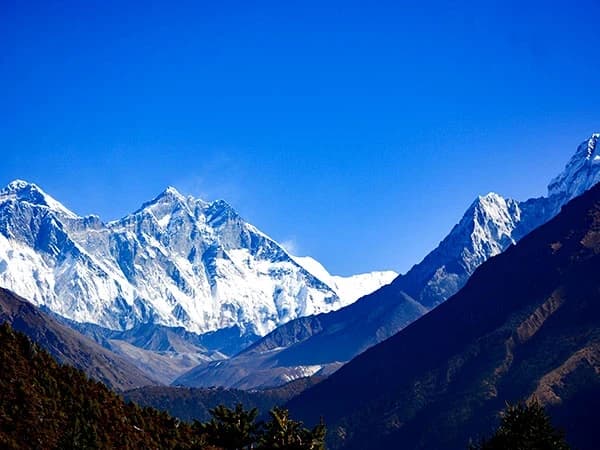
| The views | The Lhotse south face, Ama Dablam from behind, Island Peak and the Imja glacier and lake |
| Facilities | A few seasonal teahouses; simple, cold, no shops to speak of |
| Trek it on | Everest Three Passes Trek, Island Peak Climbing |
Where is Chhukung and how do you get there?
Chhukung lies at the head of the Imja valley, the branch that runs east off the main Everest Base Camp trail. From Dingboche, where most trekkers spend an acclimatisation night, the path follows the Imja Khola upstream past stone-walled potato fields and yak pasture, climbing gently for two to three hours until the lodges of Chhukung appear beneath a wall of ice. It is an easy walk on paper, but you are already above 4,400 metres when you start, so it never feels easy. There is no road, no airstrip and no shortcut. You arrive on foot, the way everyone always has.
Why do trekkers stop in Chhukung?
Three reasons, and most people come for at least two of them. The first is the Kongma La at 5,535 metres, the highest and quietest of the Everest Three Passes; Chhukung is where you sleep before you cross it. The second is Island Peak, or Imja Tse, at 6,165 metres, one of Nepal's most popular first 6,000-metre summits; Chhukung is the last village before its base camp. The third is Chhukung Ri, a walkable viewpoint peak directly above the village that doubles as the finest acclimatisation day in the Khumbu. A trek that includes Chhukung is rarely a beginner's trip. It is where the Everest region stops being a walk and starts being a mountaineering objective.
What is Chhukung Ri, and should you climb it?
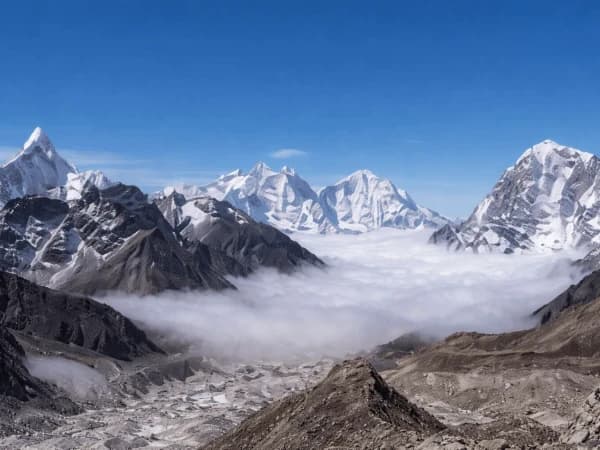
Chhukung Ri is the brown rubble peak that rises straight behind the village to about 5,550 metres. There is no technical climbing, just a steep, lung-burning walk on scree and rock, three to four hours up and half that down. I send almost everyone up it who is spending a day here, because it does two jobs at once. It is textbook acclimatisation, climb high and sleep low, which is exactly what your body needs before the Kongma La or Island Peak. And the reward at the top is one of the great Himalayan panoramas: the entire south face of Lhotse filling the sky, Ama Dablam showing its hidden back side, Makalu away to the east, and Island Peak sitting small and sharp below you in the Imja valley. If you only do one acclimatisation hike in the Khumbu, this is the one.
Chhukung as the gateway to Island Peak
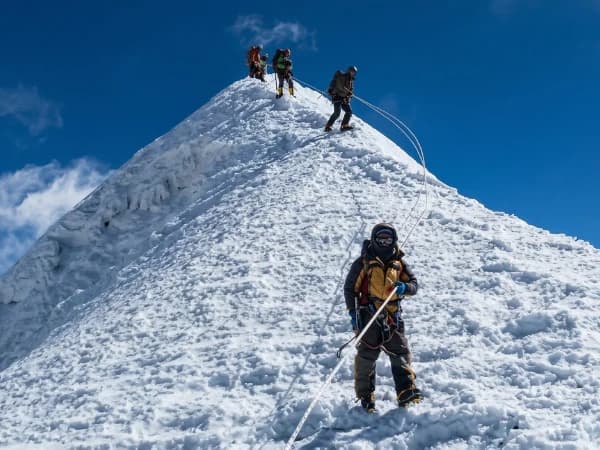
For climbers, Chhukung is the road-head for Island Peak. From the village it is a half-day walk to Island Peak Base Camp at around 5,100 metres, where the technical part of the trip begins: rope work, crampons, the summit day on snow and a fixed line up the headwall. All of that climbing equipment comes with us, and we build the itinerary so that the days at Chhukung and on Chhukung Ri do the acclimatisation work before you ever touch the mountain. It is not a coincidence that the people who summit Island Peak comfortably are usually the ones who took Chhukung seriously first.
Altitude and acclimatisation at Chhukung
At 4,730 metres, Chhukung is high enough that you must treat it with respect. Nights are cold and sleep can be broken; mild headaches are normal, real symptoms are not. The rule we follow is simple: spend the day active and high, on Chhukung Ri or a walk toward Island Peak Base Camp, then come back down to sleep, and never push on to the pass or the peak if anyone in the group is genuinely unwell. There is a Himalayan Rescue Association aid post a few hours back down the valley at Pheriche if things go wrong. Good acclimatisation is not lost time; it is what makes the hard days possible.
What facilities are in Chhukung?
Not many, and that is part of the character. Chhukung is a seasonal settlement of a few teahouse lodges that open for the spring and autumn seasons and largely close in winter. Expect a simple room, a warm dining hall around a stove, dal bhat and the usual trekking menu, and patchy phone signal. Charging and hot showers cost extra and the higher you go the more they cost. Bring what you need up from Namche or Dingboche; this is not a place to resupply.
When is the best time to go?
The two trekking seasons both work. October and November give the most stable weather and the clearest views of the Lhotse face, which is why autumn is the busiest time for the Three Passes and for Island Peak. Late March to May is the spring climbing season, warmer by day and the main window for summit attempts on Island Peak. Winter is clear but severe and most lodges close; the monsoon hides everything behind cloud. Whenever you come, build a spare day into the schedule here, because a single clear morning on Chhukung Ri or the Kongma La is worth waiting for.
Common questions about Chhukung
How high is Chhukung? The village sits at 4,730 metres. Chhukung Ri above it reaches about 5,550 metres, and the Kongma La beyond is 5,535 metres.
Do I need a guide and permits for Chhukung? Yes. You need the Sagarmatha National Park permit, the Khumbu Pasang Lhamu Rural Municipality permit and a TIMS card. The Nepal Tourism Board licensed-guide rule from April 2023 is not enforced locally in Khumbu, but we always trek with a licensed guide. We arrange all of it. Island Peak additionally needs a Nepal Mountaineering Association climbing permit, which we handle for climbers.
Is Chhukung worth it if I am not climbing Island Peak? Absolutely. Chhukung Ri is the best value acclimatisation climb in the Khumbu, and the Kongma La out of Chhukung is the wildest of the Three Passes. You do not need to be a climber to be glad you came.
How far is Chhukung from Everest Base Camp? They are in different valleys. From Chhukung you cross the Kongma La to reach Lobuche and the Base Camp trail, which is the classic Three Passes way of joining the two.
Chhukung is where the high Khumbu begins in earnest. We run it on the Everest Three Passes Trek (17 Days) and as the base for our Island Peak Climbing expedition, private, with all climbing gear provided, 2027 dates open. WhatsApp us for current departures and an honest word on if you are ready for it.
Chhukung sits within Sagarmatha National Park, managed by Nepal's Department of National Parks and Wildlife Conservation.
Shreejan Simkhada is the CEO and co-founder of The Everest Holiday, a family-run trekking company in Kathmandu, and a third-generation Himalayan guide. TAAN Member #1586. Every booking helps fund our Nagarjun Learning Center.
 Chat with Shreejan