The trail to Thame branches west from Namche Bazaar at a junction that most EBC trekkers walk past without a glance. They turn right, toward Tengboche and Everest. The trail to Thame turns left, into a valley that narrows between ridgelines and climbs gently along the Bhote Koshi river toward the Tibetan border. Within thirty minutes of the junction, the crowds vanish. The tea shops thin. The trail grows quieter. And the Khumbu that reveals itself along this path — older, more traditional, less shaped by the tourism economy — is the Khumbu that existed before the first trekker arrived.
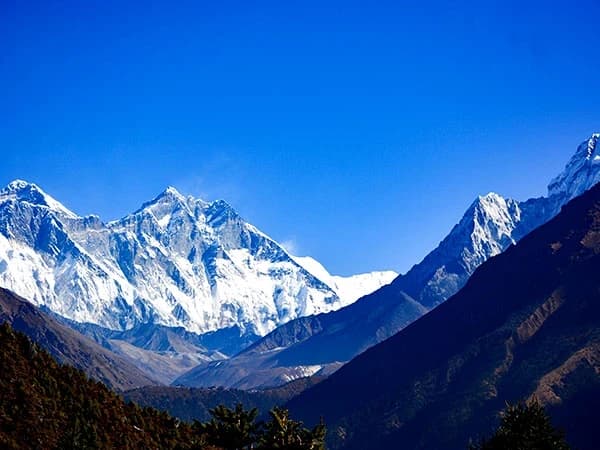
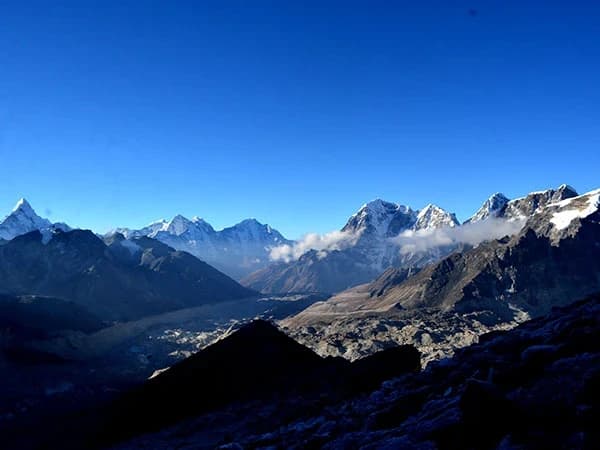
Thame sits at 3,820 metres in the upper Bhote Koshi valley, a three-to-four-hour walk from Namche. It is the ancestral home of the Sherpa community that settled the Khumbu after migrating from eastern Tibet approximately five hundred years ago. It is the village where Tenzing Norgay — the Sherpa who, with Edmund Hillary, first stood on the summit of Everest in 1953 — spent his childhood. And it is the site of Thame Monastery, one of the oldest and most important gompas in the Khumbu, perched on a hillside above the village with views that stretch from Kongde Ri to the Tibetan peaks beyond the Nangpa La pass.
Almost nobody goes there. The EBC trail pulls ninety-five percent of Khumbu trekkers toward Tengboche, Dingboche, and the glacier. Thame receives a fraction of the visitors — trekkers who have done EBC before and want something different, trekkers whose guides know the valley and recommend the detour, and the handful of climbers approaching Kongde Ri or the Nangpa La. The result is a Sherpa village that feels genuinely remote despite being a half-day's walk from Namche, the busiest settlement in the Everest region.
The Walk From Namche
The trail leaves Namche from the western edge of the town, climbing briefly above the village before contouring along the hillside above the Bhote Koshi river. The river's name, Bhote Koshi, the River from Tibet, indicates the valley's orientation. The trail follows the river upstream, northwest, toward the Nangpa La (5,716 metres), the ancient trade route between the Khumbu and Tibet that the Sherpa people crossed during their migration and that was used for salt-and-grain trade until the Chinese closure of the Tibetan border in the 1950s.
The walk is gentle by Khumbu standards, no dramatic climbs, no altitude shocks, no suspension bridges of terrifying length. The trail undulates through forest and open hillside, passing small settlements and mani walls. Thamo (3,490 metres) is the first village, a cluster of houses with a nunnery on the hillside above. Thamo Monastery, founded in the 1960s, is active and welcoming to visitors.
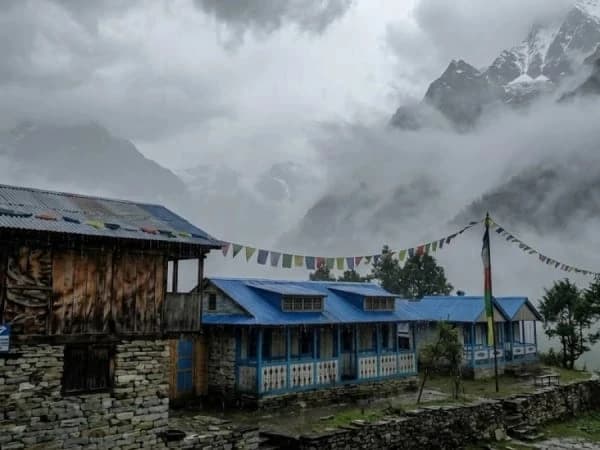
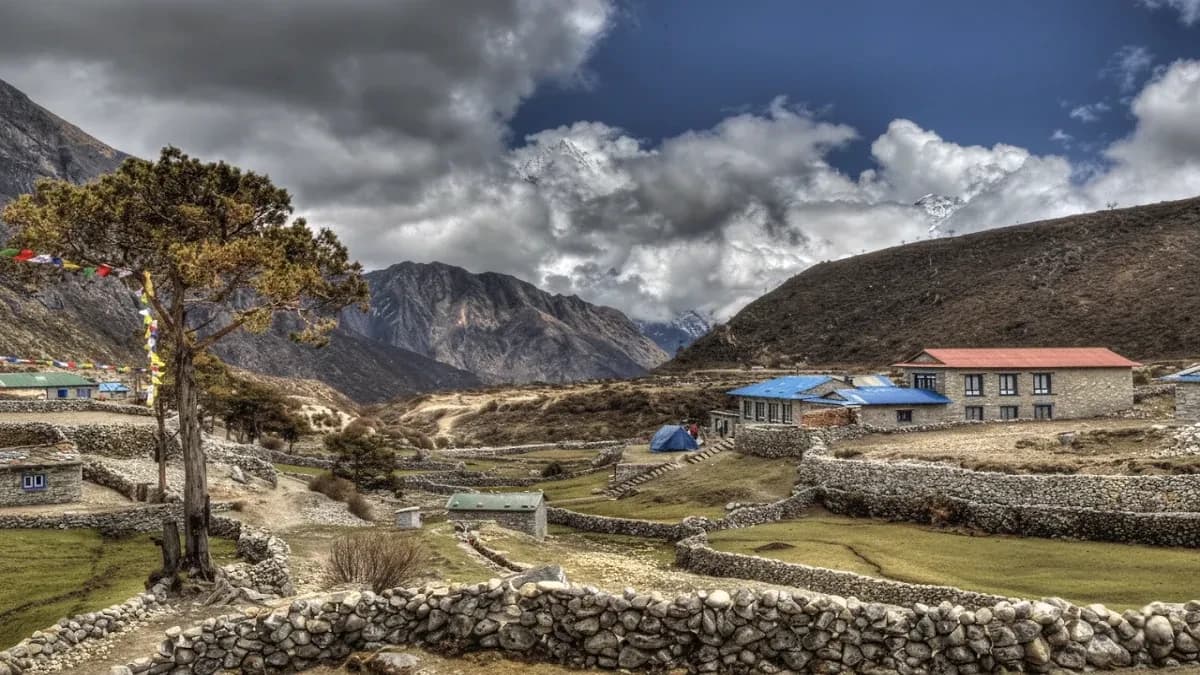
Beyond Thamo, the valley narrows and the trail crosses the river on a bridge before climbing to Thame. The approach is beautiful, terraced fields, prayer flags strung between stone walls, and the first views of Thame village itself, built into the hillside in the distinctive Sherpa style: stone houses with flat roofs, small windows, and wooden door frames painted in bright colours.
Tenzing Norgay's Village
Tenzing Norgay was born in 1914, most likely in the Tibetan village of Tsa-chu, near Makalu, though the exact location is debated. His family moved to Thame when he was young, and it was in Thame that he grew up, herded yaks, attended the monastery school, and developed the mountain skills that would eventually take him to the summit of Everest.
The house where Tenzing lived is in the upper part of the village. It is not a museum, it is a private home, still occupied by family members. There is no sign, no plaque, no visitor centre. If you ask your guide, they will point it out. The house looks like every other house in Thame, stone walls, prayer flags on the roof, a wooden door, and this ordinariness is itself the point. The first person to stand on the highest point on earth grew up in a house indistinguishable from his neighbours', in a village where the greatest mountain achievement in human history is treated as family history rather than mythology.
Thame has produced an extraordinary concentration of high-altitude mountaineers. Apa Sherpa, who held the record for the most Everest summits (twenty-one), is from Thame. Multiple other record-holding Sherpas trace their families to this village. The combination of altitude genetics, childhood exposure to high terrain, and the cultural normalisation of mountain work has made Thame arguably the most important single village in the history of Himalayan climbing.
Thame Monastery
Thame Gompa sits on a ridge above the village at approximately 3,960 metres. The monastery is reached by a thirty-to-forty-minute climb from the village on a trail that switchbacks through juniper scrub and prayer flag-draped boulders. The climb is steep but short, and the reward, the monastery itself and the views from its courtyard, justifies every step.
The monastery was founded in the sixteenth century and is one of the oldest gompas in the Khumbu. It belongs to the Nyingma tradition of Tibetan Buddhism, the oldest school, associated with Guru Rinpoche (Padmasambhava) who brought Buddhism to Tibet in the eighth century. The main prayer hall contains wall paintings, statues, and butter lamps. The monks, fewer than in Tengboche, the atmosphere more intimate, may be chanting when you arrive. Sit quietly. Listen. The sound of monks chanting in a five-hundred-year-old monastery at nearly four thousand metres, with the wind carrying prayer flag mantras across a valley that leads to Tibet, is an experience that no recording or description can reproduce.
Thame Monastery hosts its own Mani Rimdu festival, typically in May, a few months before Tengboche's October celebration. The Thame Mani Rimdu is smaller and less attended by tourists but equally authentic, masked dances, ritual drumming, and the distribution of blessed pills and sacred water. If your visit coincides with the festival, you will share the experience with the Sherpa community rather than with other tourists, a distinction that makes the celebration feel less like a performance and more like what it is: a religious ceremony that has been conducted in this location for centuries.
The Nangpa La Connection
Above Thame, the valley continues northwest toward the Nangpa La, the 5,716-metre pass that connects the Khumbu with Tibet. For centuries, this pass was the Sherpa people's lifeline, the route by which salt from Tibet was traded for grain from the Khumbu lowlands, the route by which Sherpa migrants travelled between their ancestral homeland and their new home, and the route by which Buddhist teachings, art, and religious objects flowed south from the great Tibetan monasteries.
The Nangpa La is no longer a trade route. The Chinese government closed the border, and the pass is now used primarily by mountaineers approaching Cho Oyu (8,188 metres) and by the occasional Tibetan refugee making the dangerous crossing into Nepal. But the pass remains visible from above Thame, a saddle in the ridge that marks the border between Nepal and Tibet, and knowing its history changes what you see when you look at it. That saddle is not just a geographical feature. It is the door through which an entire people walked, carrying their religion, their language, and their identity, five hundred years ago.
Practical Information
Altitude: 3,820 metres. No additional acclimatisation needed if you have already spent a night in Namche (3,440 metres).
Walking time: three to four hours from Namche Bazaar (one way). The trail is well-maintained and clearly marked. Can be done as a day trip from Namche (seven to eight hours round trip) or as an overnight stay.
Accommodation: Thame has several small lodges and teahouses. The accommodation is simpler than Namche, smaller rooms, fewer menu options, more basic facilities. This simplicity is part of the charm.
Best combined with: the acclimatisation day in Namche (Day 4 of the standard EBC itinerary). Instead of hiking to the Everest View Hotel (the standard acclimatisation hike), walk to Thame. The altitude gain is similar (3,440 to 3,820 metres), the acclimatisation benefit is identical, and the cultural experience is incomparably richer. Discuss this option with your guide before the trek, it requires adjusting the Day 4 itinerary but does not add time to the overall trek.
Permits: no additional permits needed beyond the standard Sagarmatha National Park entry and TIMS card.
Why Thame Matters
Thame is the Khumbu before the trail. Before the teahouses had menus in English. Before the lodges had Wi-Fi. Before the Everest Base Camp trail became the most famous trek in the world and drew fifty thousand visitors a year to a valley that, fifty years earlier, was visited by fewer than fifty.
Walking to Thame from Namche is walking backward in time, from the commercial present of the trekking industry to the cultural past of the Sherpa people. The village is not frozen in amber. It has electricity, mobile coverage, and children who attend school in Namche. But it has not been reshaped by tourism in the way that Namche and Tengboche and Gorak Shep have been reshaped. The teahouses exist because trekkers come, but they are not the reason the village exists. The village exists because the Sherpa people settled here five centuries ago, because the valley leads to Tibet, because the monastery anchors the community to the hillside and to its faith, and because Thame, like the mountains around it, simply endures.
The trekker who walks to Thame sees a version of the Khumbu that the EBC trail no longer provides. Not better. Not worse. Older. Quieter. Closer to the source. And the walk back to Namche, downhill, easy, the afternoon light warm on the prayer flags, carries with it the specific knowledge that the Khumbu is larger than the trail, that the Sherpa people are more than guides and lodge owners, and that the man who first stood on the summit of Everest grew up in a stone house in a quiet valley that most trekkers walk past without turning their heads.