There is a place at the end of the world — or what feels like the end — where the air holds half the oxygen of sea level, where water freezes inside your bottle by midnight, and where the most expensive cup of tea in Nepal costs three dollars and is worth every rupee. Gorak Shep sits at 5,164 metres on a sandy flat beside a frozen lake bed at the foot of Kala Patthar and the Khumbu Glacier, and it is the last settlement on the Everest Base Camp trail. There is nothing above it except rock, ice, and the mountain itself. Nothing below it except the trail you spent nine days walking up. And nothing around it except the most concentrated collection of Himalayan grandeur visible from any inhabited point on earth.
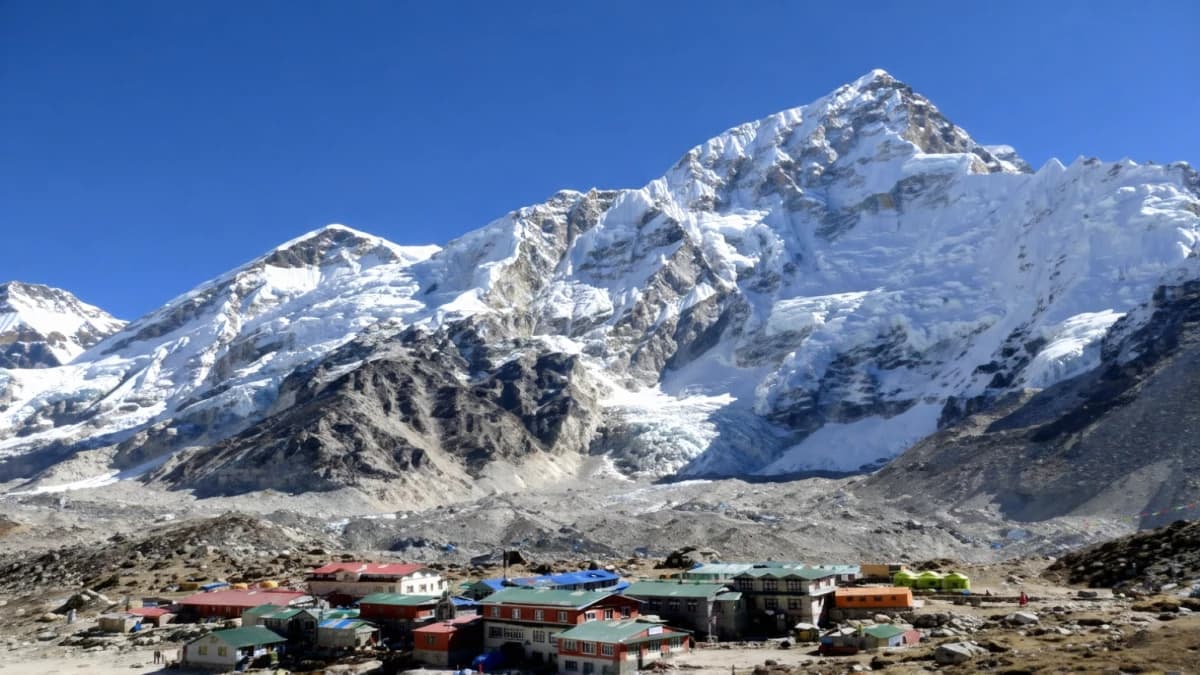
Gorak Shep is not comfortable. It is not warm. It is not a place where sleep comes easily or food tastes like anything other than fuel. It is a collection of stone teahouses huddled on a windswept flat, staffed by people whose tolerance for cold and altitude borders on the superhuman, visited by trekkers whose bodies are running on determination and dal bhat in roughly equal measure. And yet. Gorak Shep is where the EBC trek delivers its two greatest moments — the walk to Everest Base Camp and the sunrise from Kala Patthar — and those two moments are why you walked for nine days to reach this improbable, uncomfortable, remarkable place.
Arriving
You arrive at Gorak Shep from Lobuche, a walk of three to four hours across glacier moraine that is the most physically demanding non-summit section of the EBC trail. The trail crosses the lateral moraine of the Khumbu Glacier — a landscape of rubble, boulders, and frozen mud that looks like a construction site abandoned by giants. The footing is uneven. The altitude, you are above 5,000 metres for the first time, makes every step deliberate. Your breathing is audible. Your heart rate is elevated. And the scenery, Pumori to the west, Nuptse's massive wall to the north, the Khumbu Glacier spreading below like a river of grey rubble, is so dramatic that you stop to photograph it even though stopping means your lungs have to restart the rhythm that walking requires.
Gorak Shep appears as a cluster of flat-roofed buildings on a sandy plateau. The frozen lake bed, Gorak Shep Lake, dry in autumn, frozen in winter, stretches beside the settlement. The wind is constant. The air temperature, even in October sunshine, rarely exceeds five degrees Celsius. In shade or after sunset, it drops to minus five, minus ten, minus fifteen. You arrive, drop your pack at a teahouse, order tea, and sit. The sitting is not laziness. It is physiological necessity. At 5,164 metres, your body is working harder to breathe, to pump blood, to think, than it has ever worked at rest.
The Walk to Everest Base Camp
Most trekkers arrive at Gorak Shep in the late morning, eat lunch, leave their heavy gear at the teahouse, and walk to Everest Base Camp in the afternoon. The walk is approximately two to three hours each way, five to six hours total, across the Khumbu Glacier.
The trail is not a trail in any conventional sense. It is a route marked by cairns and prayer flags across the surface of the glacier, a surface that is not ice but rock rubble deposited by the glacier's slow movement. You walk over loose stones, around ice pinnacles, and across frozen streams. The terrain is grey, austere, and alien. There are no trees. No grass. No colour except the occasional prayer flag snapping in the wind and the white of the ice towers that rise from the glacier surface like sculpture.
Everest Base Camp itself is not a single point. It is a sprawling area of flat glacier where expedition teams establish their tent cities during the climbing season (April-May). In the trekking season (October-November), the camp is quieter, some expedition remnants remain, but the full-scale camping ground of spring is absent. What you see instead is the Khumbu Icefall rising above you, a cascading wall of ice blocks, seracs, and crevasses that is the first major obstacle on the climbing route to the summit. The icefall is hypnotic and terrifying in equal measure, blocks the size of houses tilted at impossible angles, the deep blue of compressed ice visible in the cracks, and the occasional distant thunder of ice calving from the glacier's moving face.
The prayer flags at base camp mark the spot where most trekkers stop, take photographs, and absorb the fact that they are standing at 5,364 metres at the foot of the highest mountain on earth. The emotion varies. Some trekkers cry. Some laugh. Some stand quietly and look at the icefall with an expression that suggests they are having a private conversation with the mountain. And some pull out their phones and call home, because the satellite signal at base camp is surprisingly good and the desire to say "I'm here" to someone who understands what "here" means is powerful.
The walk back to Gorak Shep in the late afternoon is cold and tiring. The sun drops behind Pumori by four o'clock, and the temperature falls immediately. You arrive at the teahouse in near-darkness, order soup, and crawl into your sleeping bag with every layer you own. The night at Gorak Shep is the coldest night of the trek.
Kala Patthar at Sunrise
The alarm goes off at four in the morning. Or rather, your guide knocks on the door at four, because your phone died in the cold and the alarm did not sound. You unzip the sleeping bag and the cold hits like a wall. Minus fifteen. Minus twenty. The kind of cold that makes your fingers fumble with zippers and your brain resist the idea of leaving the bag. Every layer goes on. Boots, frozen from the night, stiff and resistant. Down jacket. Balaclava. Gloves. Headlamp.
The climb from Gorak Shep to Kala Patthar gains 381 metres in altitude, from 5,164 to 5,545 metres. The trail is steep, rocky, and exposed. In the dark, with only headlamps for illumination, the climb is a tunnel of light and breathing and the crunch of frozen scree underfoot. You climb for ninety minutes. The world shrinks to three things: the circle of your headlamp, the sound of your lungs, and the knowledge that the view at the top is why you came to Nepal.
And then the sky brightens. The eastern horizon turns from black to grey to pale blue. The stars fade. The peaks emerge, first as dark shapes, then as outlines, then as the full, illuminated reality of the highest mountains on earth. Everest appears. Not as a distant triangle but as a massive, dark, triangular summit directly ahead, separated from you by the Khumbu Glacier and eight kilometres of air so thin it tastes like metal.
The sun hits the summit. A line of gold on the highest point on the planet. The gold spreads, down the summit pyramid, across the South Col, along the ridge to Lhotse. The Khumbu Icefall catches the light and turns from grey to white to blazing silver. Nuptse's wall, which was a shadow, becomes a wall of orange and gold. And you, standing at 5,545 metres, breathing air that is barely sufficient, tears frozen on your cheeks from the wind or the emotion or both, you are watching the most famous sunrise in the world from the highest point you will ever stand.
This is why people walk for nine days. This is why they endure altitude headaches and cold teahouses and frozen water bottles and sleepless nights. This moment. This light. This mountain. This specific, unreproducible, earned experience of standing above five thousand five hundred metres and watching the sun ignite the highest peak on earth.
The Teahouses
Gorak Shep has four or five teahouses. They are the most basic accommodation on the EBC trail, small rooms, thin mattresses, no heating except the common room stove, and temperatures that drop below freezing inside the building by midnight. The walls are stone. The windows are single-glazed. The bathroom is outside, a short, brutally cold walk in the dark that every trekker dreads and every trekker makes at least once per night.
The food is dal bhat and noodle soup. The menu is shorter than at lower teahouses because every ingredient, every grain of rice, every packet of noodles, every tea bag, was carried here on someone's back from Lukla or Namche. The prices are the highest on the trail: three hundred to five hundred rupees for a cup of tea, six hundred to eight hundred for a plate of dal bhat. These prices are not exploitation. They are the genuine cost of providing food at 5,164 metres in a place where a porter carries thirty kilograms for two days to deliver the supplies that feed you for one meal.
Charging your phone costs five hundred rupees per device. Wi-Fi, if it works, costs five hundred rupees and delivers speeds that make loading a webpage feel like an achievement. Hot water for washing does not exist. The toilet paper roll in the bathroom is frozen.
None of this matters. You are not at Gorak Shep for comfort. You are at Gorak Shep for Everest. And Everest, visible through the teahouse window as a dark triangle against the star field, does not care about your shower, your Wi-Fi, or the temperature of your room. It cares about nothing. It is simply there, enormous, indifferent, and so close that the distance between you and the highest point on earth can be measured not in metaphors but in kilometres.
Altitude at Gorak Shep
At 5,164 metres, your blood oxygen saturation is typically 75-85 percent, down from 95-100 percent at sea level. Your heart rate at rest is elevated by twenty to thirty beats per minute. Your breathing rate is increased. Your appetite is suppressed. Your sleep is fragmented by periodic breathing, the oscillation between deep breaths and shallow pauses that altitude forces on the sleeping brain.
These are normal physiological responses. They are not symptoms of illness, they are symptoms of altitude. The headache that most trekkers experience at Gorak Shep is caused by the same mechanisms that cause the headache at Dingboche, just more pronounced. Paracetamol helps. Hydration helps. And the knowledge that you will descend tomorrow, that the air will thicken, the headache will fade, and your body will recover with each hundred metres of altitude lost, helps most of all.
Your guide checks your SpO2 with a pulse oximeter. A reading of 78 with a headache that responds to paracetamol is normal. A reading of 65 with confusion, vomiting, or inability to walk straight is not normal, it is a sign of serious altitude illness, and your guide will initiate immediate descent. The difference between "uncomfortable but safe" and "in danger" at Gorak Shep is a judgment call that your guide makes with your life in the equation. Trust the guide. The guide has been here a hundred times. You have been here once.
Leaving Gorak Shep
After Kala Patthar, after the sunrise, the photographs, the tears, and the slow, triumphant descent back to the teahouse for tea and porridge, you leave Gorak Shep. The descent to Pheriche or Dingboche takes five to seven hours, dropping over seven hundred metres of altitude. The change is immediate and dramatic. The air thickens. The headache fades. Your appetite returns. Your legs, which felt like lead at 5,164 metres, feel like they belong to a different person at 4,400 metres. The oxygen that your body has been craving for two days floods back in, and the sensation, the physical, measurable, joy-producing sensation of breathing air that is almost enough, is one of the great unsung pleasures of high-altitude trekking.
You look back once. Gorak Shep is invisible, hidden behind the moraine, swallowed by the glacier landscape. Kala Patthar is a brown bump on the ridge. And Everest, which was right there this morning, catching the first light, close enough to feel personal, Everest is receding behind Nuptse and Lhotse, becoming once again the distant white triangle that you first saw from Namche, nine days and a lifetime ago.
You carry the sunrise with you. Not in your camera, though it is there, inadequately captured in two hundred photographs that will never reproduce the cold or the breathing or the tears. You carry it in the specific knowledge that you stood at 5,545 metres and watched the sun rise over the highest mountain on earth, and that the memory of that moment, the gold light, the thin air, the frozen tears, the absolute silence of a mountain that does not need your approval to be magnificent, is now part of who you are. Permanently. Irreversibly. Earned.