

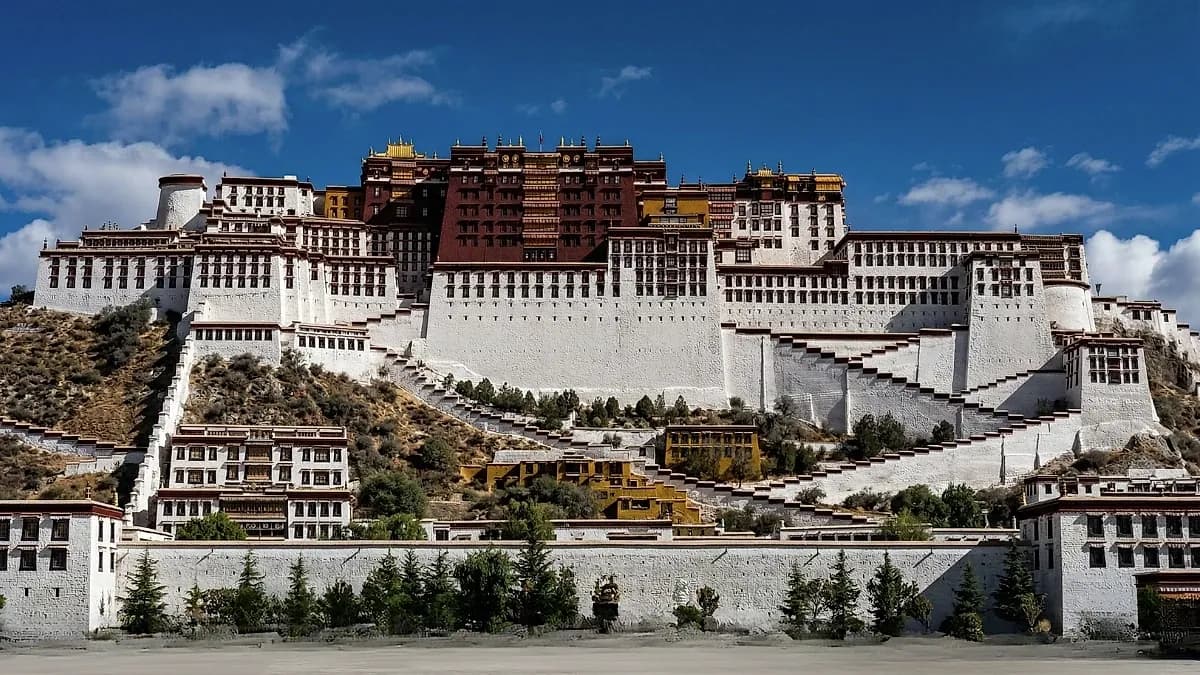
There are places in the world that people only visit. Then there are places that people see. The Potala Palace in Lhasa, Tibet, is a clear example of the second type. It doesn't only sit on Marpo Ri (Red Hill); it rises from it, as if the mountain itself wanted to go up to heaven, carrying the prayers of a thousand years on its back.
The Potala is more than just a building; you can see it from anywhere in the old city. It is a declaration. The Tibetan skyline has been painted in harsh, uncompromising white and red for almost three centuries. It is a declaration of religion, a fortress of power, and a labyrinth of secrets.
Who built Potala Palace and when was it constructed?
One must first comprehend the name of the Potala to understand it. It comes from Mount Potalaka, the legendary home of Avalokiteshvara, the Bodhisattva of Compassion. Tibetans believe that the Dalai Lamas are the living embodiment of this god. So, the palace was never merely a home; it was a holy place on Earth.
The 5th Dalai Lama, Ngawang Lobsang Gyatso, who unified Tibet and wanted a seat of power that matched his spiritual and political strength, started building in 1645. He erected it atop the remains of a meditation cave and a minor stronghold from the 7th century that King Songtsen Gampo used to own. The White Palace was the first building to be finished. It was the administrative headquarters and the Dalai Lama's home. After he died, the Red Palace was built to hold his stupa and those of his successors.
When you step through its gates, you are not only strolling through history. You are wandering through a cosmos that is made of wood, stone, and gold.
The Palace has two sides: white and red.
The Potala is a lesson on how things may be both. The White Palace and the Red Palace are the two primary parts of the building. They reflect the secular and the sacred, the earthly and the divine, all in one beautiful building.
The White Palace: The Place Where Power Lies
The White Palace is a huge, cascading cascade of whitewashed walls that make up the basis of the whole complex. Festivals spill milk, lime, and honey over the walls, giving them their colour. It stands for peace and purity.
The Dalai Lamas lived in the building's many hallways, and the Kashag (the Tibetan cabinet) worked there. Official ceremonies took place in the enormous eastern and western courtyards. The sunshine here comes through old wooden windows and makes long shadows on the flooring that has been worn smooth by the feet of monks, ministers, and messengers who once changed the course of Tibetan history.
The most important room is the holy throne room, where the Dalai Lama would meet people and hold court. The air is thick with the memories of power, which was both political and deeply spiritual.
The Divine House, or The Red Palace
The Red Palace is the state's soul, while the White Palace is its body. This primary building is painted a rich, powerful red, which is a hue that stands for compassion and the angry energy needed to safeguard the faith. It is just for Buddhist practise and worship.
The walls slant inward on purpose, which makes the huge building look like it is moving naturally, as if it is living and breathing. There are chapels, gathering halls, and libraries inside.
The collection of stupas (tombs) of the Dalai Lamas is the most important part of the Red Palace. These tombs are not simple to find. Some of them are many stories tall and are made of gold and jewels. The stupa of the 5th Dalai Lama is the most beautiful. It is covered in about four tons of gold and has hundreds of diamonds, pearls, turquoise, and coral in it. When you stand in front of it, you can feel the weight of devotion, which is the physical representation of a culture's love for its spiritual leaders.
What can you see and experience inside Potala Palace?
Going to the Potala means giving up your sense of direction. There isn't a big, straight street that goes to one hall. Instead, the tide of pilgrims and visitors pushes you up a set of whitewashed steps that go in a zigzag pattern. You have to slow down and feel the height of the climb as you look down at the city of Lhasa below.
The world gets smaller inside. Corridors are narrow, ceilings are low, and the air is thick with the smell of yak butter burning in thousands of flickering lamps. There are shafts of dusty light that break up the gloom and show fearsome guardian gods painted on the walls.
There are murals on every surface. They aren't just decorations; they're visual scriptures. They tell the narrative of the Buddha's life, the lives of Tibetan rulers, and how the palace was built. Monks used to spend their whole lives painting these walls, and their brushes moved in sync with their prayers, making the plaster itself a prayer.
You walk through chapels that are dedicated to certain gods. In one, a massive statue of Maitreya, the Future Buddha, gazes down with serene promise. In another, the powerful figures of Dharmapalas (Dharma defenders) stomp on ignorance and pride. The hush within is so strong that you can hear the faint shuffle of feet and the distant chanting in the thick air. Related: Lhasa City: Roof of the World Travel Tips and Attractions.
What treasures and artefacts are housed inside Potala Palace?
The Potala is also a record of Tibetan culture. It has a huge number of items,
-
Sutras and Scriptures: Thousands of manuscripts, some of which are whole books written in gold, silver, and turquoise ink on dark blue handmade paper.
-
Thangkas are huge silk scroll paintings. Some are so big that they can only be hung on the outside walls during certain festivals.
-
Relics: Things that belonged to prior Dalai Lamas, like their robes, seals, and other ceremonial items.
-
Gilded Sculptures: Thousands of statues of Buddhas, bodhisattvas, and historical masters, each one a work of art from the Himalayas.
People say that the Potala has enough gold to cover the whole earth. The feeling, whether genuine or not, depicts the huge amount of money that was given to this place, not for personal gain, but as the highest form of gift.
How do you visit Potala Palace and what should visitors know?
Preparation is crucial for those lucky enough to be able to visit this holy zone.
-
The Ascent: The ascent to the entrance is difficult. The palace steps provide another 100 metres of vertical rise to the already high altitude of Lhasa, which is over 3,600 metres. Take your time. Let the older people and the pilgrims go by. It's okay to stop and take a breath; the vista of Lhasa opening up below you is worth it.
-
The Route: The trail for visitors goes through the White Palace, up into the Red Palace, and then down the rear of the hill. You can't go back once you're in. It is a small version of a pilgrimage.
-
When: Early in the morning is optimal. The sun hits the palace walls as it rises, making them shine. The light within the chapels is also at its most beautiful.
-
Respect: the chapel is not a museum; it is a place of prayer that is always open. Talk quietly. Don't point at statues. Take off your hat when you go into a chapel. Taking pictures is generally prohibited in the most sacred places.
Why is Potala Palace spiritually significant to Tibetan Buddhism?
The Potala Palace has withstood invasions, political turmoil, and the slow but steady erosion of time. It has been a fort, the seat of government, a winter palace, and now a World Heritage Site. But labels don't really explain what it is.
You can see the Lhasa Valley from the roof, with the Kyichu River winding below and the mountains rising in the distance. The Potala is like a Tibetan mantra in that it is carved into the soil, repeated over and over again, and always leading to something higher.
It is the frozen prayer of a nation, a sign of trust that God can live on Earth and that people can create a bridge to God with their hands.
Related Treks & Guides
- Kailash Mansarovar Tour 15 - Days Itinerary and Cost
- Kailash Trek via Simikot: 20 - Day Sacred Pilgrimage & Adventure
- Kailash Mansarovar Helicopter Tour
- Dolma La Pass (5,630m)
- Lake Manasarovar
The Potala Palace is the building that defines Tibet. Thirteen storeys of white and red rising from a hilltop in Lhasa, built for the Dalai Lamas, now a museum that holds a thousand years of Tibetan Buddhist history. Walking through it takes three hours. Processing what you saw takes longer. If your Kailash trip passes through Lhasa, do not rush the Potala. Give it a full morning.
We include Lhasa sightseeing on our Kailash Mansarovar Tour.
WhatsApp:+977 9810351300
Email:[email protected]
Written by Shreejan Simkhada, CEO of The Everest Holiday and third-generation Himalayan guide. TAAN Member #1586.
Potala in Lhasa is day 1 on our Kailash Overland. Our Kailash Mansarovar Overland Yatra (14 Days) is private (your group only, no strangers), private departures on your dates, pricing on request. WhatsApp us for tailored 2027 dates and current departures.

 Chat with Shreejan