

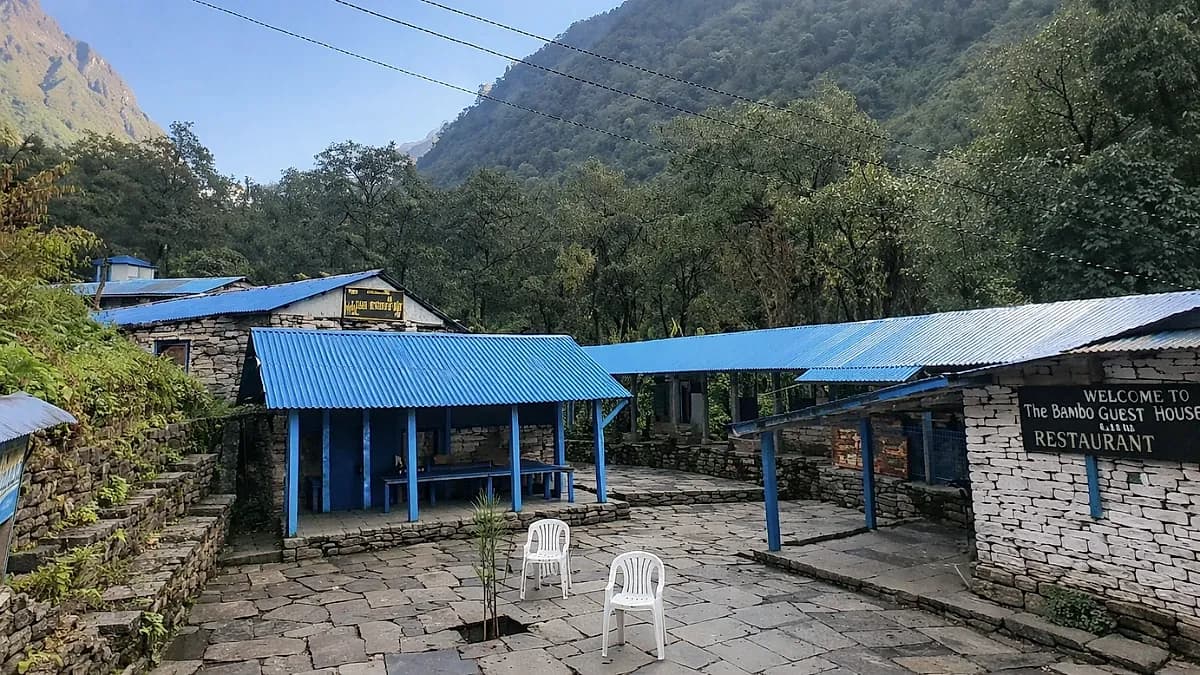
Short answer: Bamboo (2,310 m) is a small teahouse stop in the bamboo forest of the Modi Khola gorge on the Annapurna Base Camp trail, below Sinuwa, and most trekkers sleep there on the way up or on the way down. It is green, damp and shaded, with basic rooms and the river and waterfalls close by. It is a night on our Annapurna Base Camp trek.
The trail drops into a gorge so deep and so green that the mountains vanish. One hour ago you were looking at Annapurna South and Hiunchuli from the ridge at Sinuwa, the peaks white and enormous against a blue sky. Now you are walking through bamboo. Thick, tall, creaking bamboo that closes overhead like a tunnel and filters the sunlight into green shafts that move with the wind. The sound changes too, from the open-air silence of the ridge to the enclosed, rustling, dripping soundtrack of a subtropical gorge at 2,310 metres. Somewhere above, the Himalaya continues to exist. Down here, it might as well be a different country.
Bamboo Village, the name is literal, the village sits in a bamboo forest, is one of the least celebrated stops on the Annapurna Base Camp trail and one of the most atmospheric. It occupies a narrow shelf on the eastern bank of the Modi Khola river, deep inside the gorge that leads to the Annapurna Sanctuary. The teahouses are small, the rooms are basic, and the menu is the same dal bhat you have eaten at every stop since Ghandruk. But the setting, a subtropical forest at the bottom of a Himalayan gorge, with the river thundering below and waterfalls dropping from cliffs above, is unlike anything else on the ABC trail or, arguably, on any trek in Nepal.
How Do You Get to Bamboo from Sinuwa?
Bamboo is reached by a steep descent from Sinuwa (2,360 metres), a drop of roughly fifty metres that takes thirty to forty-five minutes through dense forest. The trail is stone steps, worn smooth and often wet from the moisture that the gorge traps. The forest is layered, rhododendron and oak above, bamboo below, moss covering every surface that holds still long enough. The air is humid, warm by Himalayan trekking standards, and heavy with the scent of decomposing leaves and wet earth.
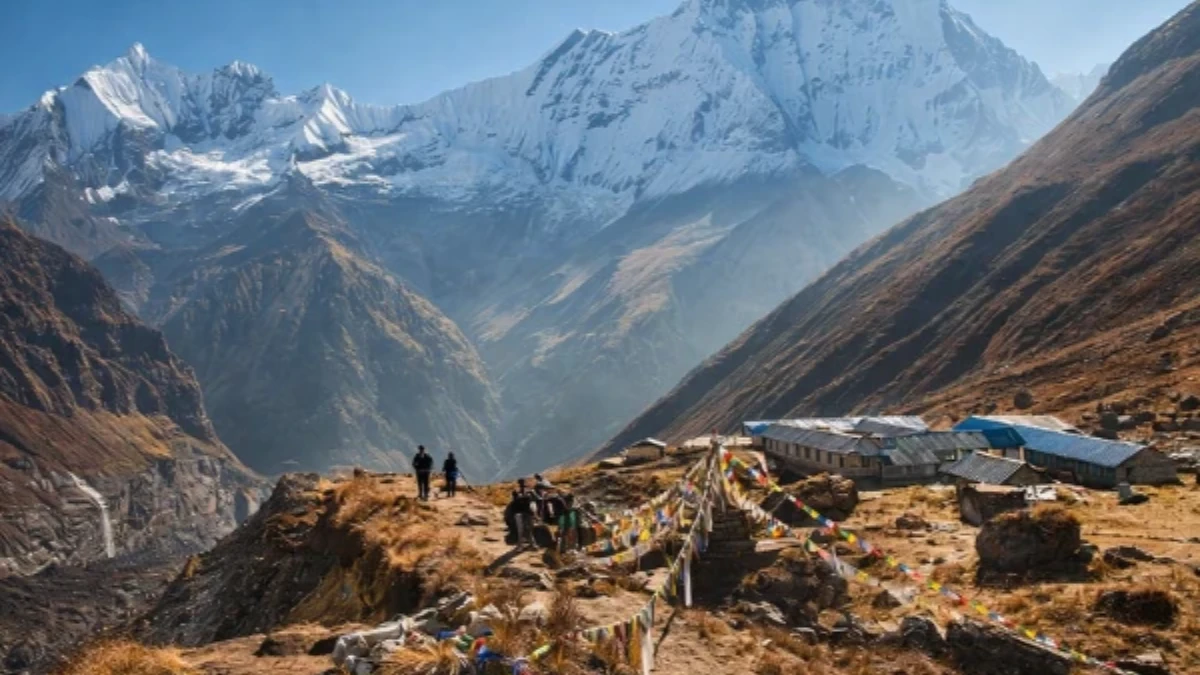
The bamboo forest begins about halfway down the descent. The stems are thick, some as wide as a human arm, and they grow so close together that the trail weaves between them like a path through a living maze. When the wind blows, the entire forest moves, the stems flexing, creaking, rubbing against each other with a sound that is halfway between a door hinge and a whale song. At night, the creaking is constant and eerie. During the day, it is atmospheric and beautiful.
The Modi Khola is audible throughout the descent, a bass rumble that gets louder as you drop. By the time you reach Bamboo Village, the river is close enough to feel the mist from its rapids. The water is glacial blue-white, meltwater from the Annapurna Sanctuary, carrying ground rock in suspension that gives it the opacity and colour of diluted milk. The river is powerful. It has carved this gorge over millennia, and the sound of its work, constant, deep, vibrating through the ground beneath your feet, is the soundtrack of Bamboo Village. Related: Jhinu Danda: The Natural Hot Springs on the Annapurna Base Camp Trail.
What Is Bamboo Village Like on the ABC Trek?
Bamboo Village has three or four teahouses lined along the trail on the river bank. The teahouses are simple, stone and timber construction, tin roofs, small rooms with two beds and a window that looks into bamboo or up at the gorge wall. There is no mobile signal at Bamboo (or there was not until recently, coverage extends further each year). There is no Wi-Fi. There is electricity, generated by a micro-hydro system powered by the river.
The food is standard teahouse fare, but the vegetables at Bamboo are fresher than at higher stops, the lower altitude supports kitchen gardens, and some teahouses grow their own greens, herbs, and chillies. The dal bhat at Bamboo may include fresh spinach or mustard greens that you will not see above the tree line.
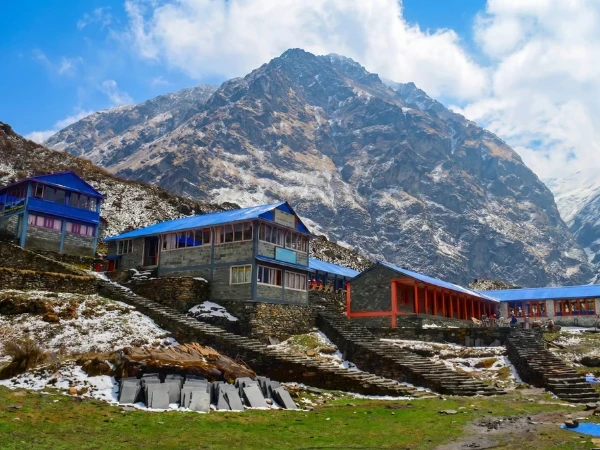
The teahouse common rooms at Bamboo are warm without the stove, the subtropical climate at 2,310 metres keeps nighttime temperatures at ten to fifteen degrees in October. You eat dinner without your fleece. You sleep with a single blanket. The contrast with the altitude cold above, which you are either heading toward or have just descended from, is one of Bamboo's quiet pleasures.
What Wildlife Can You See Near Bamboo?
The bamboo forest and the surrounding gorge are rich habitat for wildlife that the higher, more barren sections of the trail cannot support.
Langur monkeys. The grey langurs of the Modi Khola gorge are frequently seen in the forest canopy above Bamboo. They travel in troops of ten to thirty, crashing through the branches with a disregard for gravity that is impressive and alarming in equal measure. Their alarm calls, a sharp, barking cough, echo through the gorge and often alert you to their presence before you see them.
Himalayan tahr. Wild goats with shaggy brown coats and curved horns, tahr are sometimes visible on the cliff faces above Bamboo. They graze on near-vertical rock faces with a nonchalance that makes human trekking look absurdly cautious. Early morning is the best time to spot them, they move to the cliff edges to catch the first sunlight.
Danphe (Himalayan monal). Nepal's national bird, a pheasant-sized bird with iridescent plumage that flashes green, purple, red, and gold, inhabits the forest around Bamboo. Males are spectacularly coloured; females are drab brown. The male's display call, a rising whistle followed by a metallic "chip", is distinctive and, once learned, heard frequently in the forest.
Red panda. The bamboo forest is red panda habitat. These elusive, nocturnal animals are rarely seen, they feed on bamboo shoots at night and sleep in tree forks during the day, but their presence in the Modi Khola gorge is confirmed by camera trap surveys. Seeing one on the trail would be extraordinarily lucky, but knowing they are in the forest above you as you eat dinner at the teahouse adds a dimension to the setting that the visible world does not contain.
Are There Leeches on the ABC Trek?
In monsoon season (June-September) and in the wet weeks of late May and early October, the bamboo forest around Bamboo Village is leech territory. The leeches are small, one to three centimetres when unfed, and they attach to exposed skin as you walk through wet vegetation. They are harmless, painless (their saliva contains an anaesthetic), and medically insignificant. They are also, for most trekkers, psychologically distressing.
Prevention: tuck trousers into socks. Wear gaiters if you have them. Apply DEET repellent to socks and lower trousers. Check for leeches at every rest stop, particularly between the toes, behind the ears, and around the ankles. Removal: salt detaches them instantly. A lighter flame works. Pulling them off is effective but causes more bleeding because the anticoagulant in their saliva prevents clotting for ten to thirty minutes after removal.
The leeches disappear above approximately 2,500 metres. By Deurali, they are gone. By MBC, they are a memory. And by ABC, where the temperature drops below zero and the landscape is bare rock and ice, the idea that leeches exist on the same trail feels like a story from a different trek, which, in a sense, it is. The ABC trail crosses from leech country to ice country in three days, and the ecological range this represents is one of the trek's most remarkable features.
Should You Stop at Bamboo Going Up or Coming Down?
Bamboo Village is experienced twice, once on the way to ABC and once on the return. The two experiences are different.
On the way up: Bamboo is Day 3 or Day 4 of the trek. You are fresh. The altitude is comfortable. The forest is new and exciting. The river is dramatic. The wildlife is a novelty. The teahouse is your third or fourth, and the routine is still being established. You sleep well. You eat well. And you walk out of Bamboo the next morning toward Dovan and Himalaya Hotel with the specific energy of a trekker who is heading up, toward the mountains, toward the Sanctuary, toward the experience that brought them to Nepal.
On the way down: Bamboo is Day 7 or Day 8. You have seen ABC. You have stood at 4,130 metres and watched the sunrise on Annapurna. You have descended from the Sanctuary through MBC and Deurali, losing altitude and gaining oxygen with every step. By the time you reach Bamboo, the mountain adventure is behind you and the valley experience is returning. The forest feels different, not new but familiar, not exciting but comforting. The warm air, the green light, the river sound, these are the sensory markers of a body returning from altitude to the world it knows, and the relief is physical and emotional.
The dal bhat at Bamboo on the way down tastes better than any meal you ate above. Your appetite, suppressed by altitude for three days, returns at 2,310 metres with a force that surprises you. You eat one plate. Then another. The teahouse cook, watching you eat, smiles, because this happens with every trekker who descends from the Sanctuary, and the appetite is itself a celebration of the body recovering from altitude and remembering what it feels like to be hungry. Related: Deurali on the Annapurna Sanctuary Trek: The Gateway Where the Forest Ends and the Mountains Begin.
What Makes Bamboo Different from Other ABC Stops?
Bamboo Village at night is one of the most distinctive soundscapes on any Nepal trek. The river, constant, deep, vibrating through the rock beneath the teahouse. The bamboo, creaking in the wind, a sound so organic and so strange that first-time visitors sometimes mistake it for animal calls. The occasional crack of a rock falling from the gorge wall, distant, sharp, a reminder that the gorge is an active geological feature, not a static landscape. And the silence between these sounds, the silence of a gorge floor where no road noise, no engine noise, no electronic noise reaches.
Lie in your bed at Bamboo Village and listen. The river. The bamboo. The rock. The silence. These are the sounds of a place that was here before the trail was built and that will be here after the last trekker leaves. The mountains change slowly, glaciers advance and retreat over centuries. The gorge changes slowly, the river cuts deeper by millimetres per year. And the bamboo grows and dies and grows again in a cycle so fast that the forest you walk through today is not the forest that last year's trekkers walked through. Everything in the gorge is moving. You are passing through. And the sounds that you hear at night, the river, the creaking, the silence, are the sounds of passing through a place that does not pause for your presence but welcomes it, briefly, before the trail carries you up to the mountains or down to the road.
Bamboo is a rest stop on the Annapurna Base Camp Trek, sitting between Chomrong and Deurali in the densest section of forest. The nine-day itinerary passes through here on both the way up and down.
Bamboo is the village in the Annapurna Sanctuary where the forest closes in and the light turns green. The bamboo thickets are dense, the trail is narrow, and the sound of water is everywhere. It is the quietest section of the ABC trek, and after the open hillsides above Chomrong, the contrast is striking.
Bamboo is on our Annapurna Base Camp Trek.
WhatsApp:+977 9810351300
Email:[email protected]
Written by Shreejan Simkhada, CEO of The Everest Holiday and third-generation Himalayan guide. TAAN Member #1586.
Bamboo is the lodge stop before Sinuwa on ABC. Our Annapurna Base Camp Trek (9 Days) is private (your group only, no strangers), 2027 dates open, From USD $725. WhatsApp us for tailored 2027 dates and current departures.

 Chat with Shreejan