

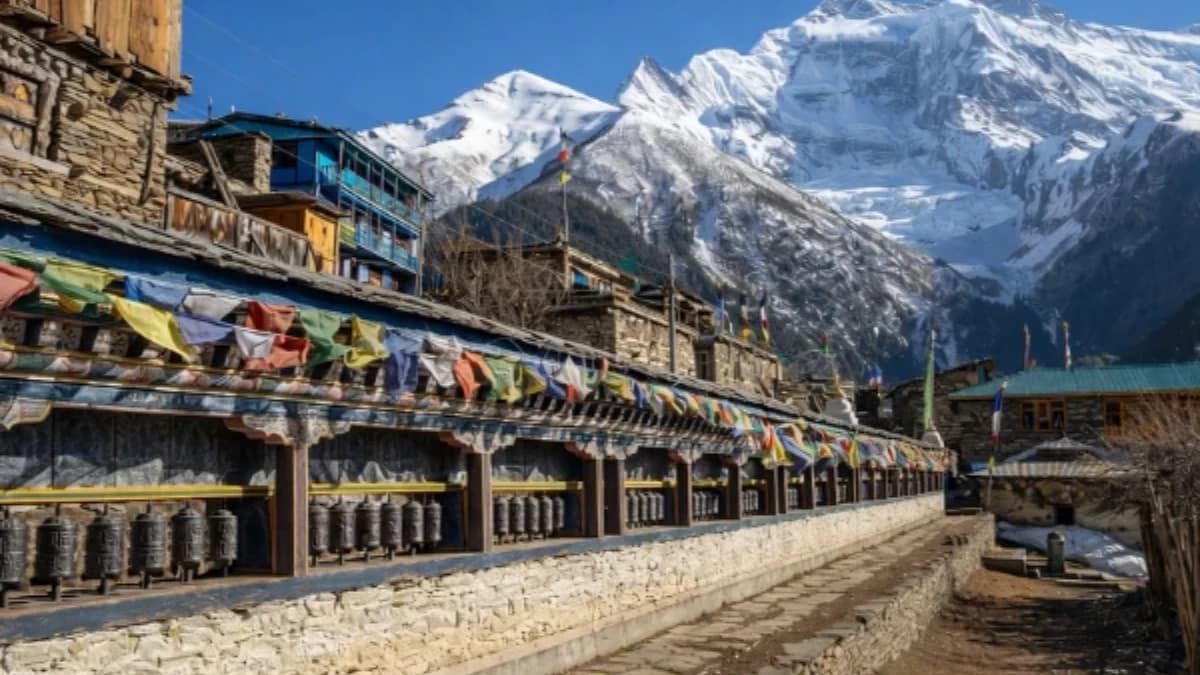
At Pisang, the Annapurna Circuit offers its first real choice. The trail splits. Left goes to Lower Pisang: flat, fast, along the river, the route that most trekkers take because it is easier and because their guides, managing groups of varying fitness, default to the path of least resistance. Right goes to Upper Pisang: steep, climbing three hundred metres above the valley floor to a ridge where a monastery sits among prayer flags and the Annapurna range fills the northern sky with a wall of ice that the lower trail, constrained by the valley walls, cannot see.
The choice between Upper and Lower Pisang is the choice between convenience and reward. Both trails reach the same place: Manang, two days further along the Circuit. Both cover approximately the same distance. The difference is elevation: Upper Pisang climbs to 3,310 metres while Lower Pisang stays at 3,185 metres. The additional 125 metres of altitude and the ridge walking that the upper trail provides deliver views, cultural immersion, and acclimatisation benefits that the lower trail does not.
Most trekkers take the lower trail. The trekkers who take the upper trail (who accept the climb, who trust their guide's recommendation or their own curiosity) discover a version of the Annapurna Circuit that the valley floor cannot provide.
What is Upper Pisang village known for?
Upper Pisang is a traditional Manangi village perched on a ridge above the Marsyangdi valley. The houses are Tibetan-style, flat-roofed stone buildings with small windows and thick walls, arranged in terraces up the hillside. Prayer flags cross every gap between buildings. Mani walls line the trails. And the gompa at the top of the village, visible from the trail below as a white speck against the brown hillside, provides the visual and spiritual anchor that traditional Himalayan village architecture requires.
The monastery at Upper Pisang is one of the oldest on the Annapurna Circuit. The main prayer hall contains wall paintings that are faded but intact, depicting Buddhist deities and scenes from the Jataka tales (stories of the Buddha's previous lives). The monastery is usually open to visitors, remove shoes, walk clockwise, leave a small donation. If monks are present, they may offer tea. The combination of the monastery's age, its setting on the ridge, and the views from its courtyard make it one of the cultural highlights of the Circuit that most trekkers miss by taking the lower trail.
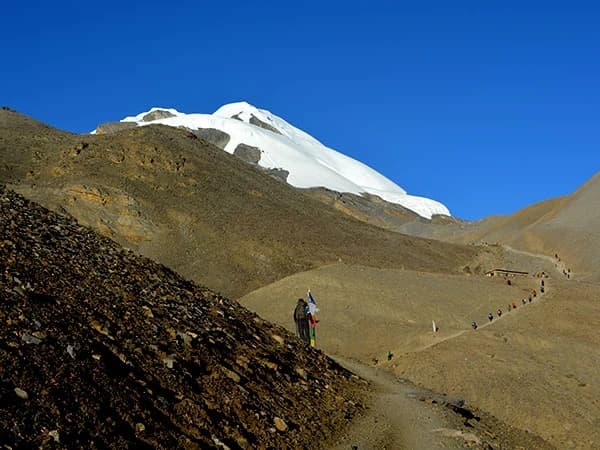
The views from Upper Pisang are the primary reason to climb. The village sits at a height and angle that reveals the Annapurna range in a panorama that the valley floor cannot match. Annapurna II (7,937 metres) dominates the north, a massive wall of ice and rock that from this elevation feels close enough to touch (it is not, it is fifteen kilometres away, but the thin air and the absence of atmospheric haze compress the distance). Annapurna IV and Gangapurna are visible to the northeast. And the Pisang Peak (6,091 metres), one of the trekking peaks accessible from the Circuit, rises directly above the village, its summit ridge visible from the monastery courtyard.
What is Lower Pisang village like for trekkers?
Lower Pisang is a trekking settlement, teahouses and lodges built to serve the Circuit trail, located on the valley floor beside the Marsyangdi river. The accommodation is comfortable by Circuit standards: clean rooms, a common room with a stove, and a menu that reflects the cultural transition from the Hindu-influenced lowlands to the Buddhist-influenced highlands, Tibetan bread, thukpa, and yak butter tea appear alongside the dal bhat and noodle soup of the lower sections.
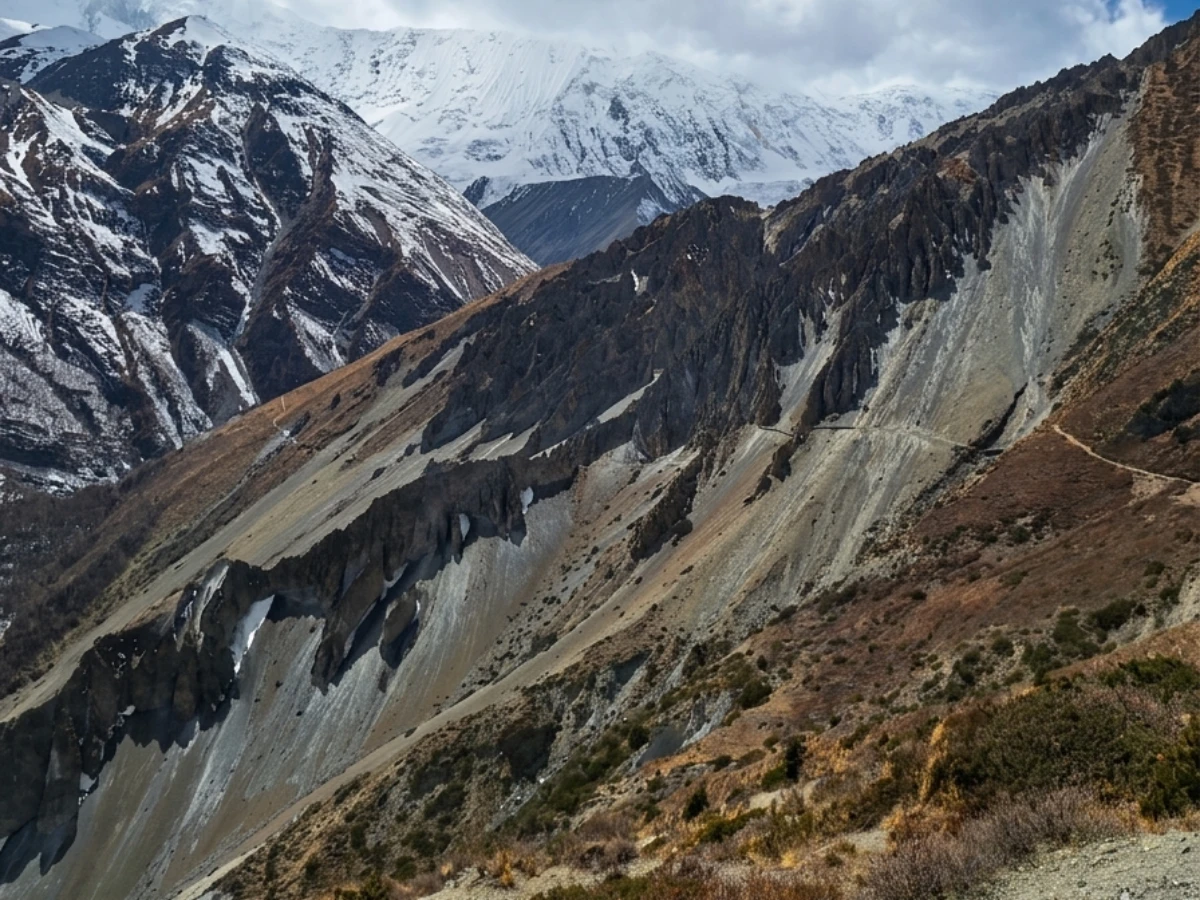
Lower Pisang has a famous viewpoint, a flat area near the river from which Annapurna II is visible above the valley wall. The view is good but not comparable to Upper Pisang's panorama, because the valley walls restrict the angle and the lower elevation compresses the visual field. The teahouse terraces at Lower Pisang face north toward the mountain, and the sunset light on Annapurna II from Lower Pisang is worth watching, but from Upper Pisang, the same sunset is watched from three hundred metres higher with a wider field that includes peaks the lower village cannot see.
What Is the Walk Between Upper and Lower Pisang Like?
If you stay in Lower Pisang (as most itineraries schedule), you can still visit Upper Pisang as a side trip, a ninety-minute round trip that climbs the hillside between the two settlements. The path is clear, steep, and rewarding. This compromise delivers the monastery visit and the views without the commitment of the full upper trail from Bratang.
If you take the upper trail from Bratang (the approach before Pisang), you pass through Upper Pisang and continue along the ridge to Ghyaru and then to Ngawal, a ridge walk of three to four hours that is widely considered the finest single section of the Annapurna Circuit. The ridge trail provides continuous views of the Annapurna range to the north, the Marsyangdi valley below to the south, and the high peaks of the Manang valley ahead to the northeast. The walking is moderate, undulating rather than climbing, and the setting is open and exposed, with prayer flags at every high point and chortens at every village.
How hard is it to climb Pisang Peak?
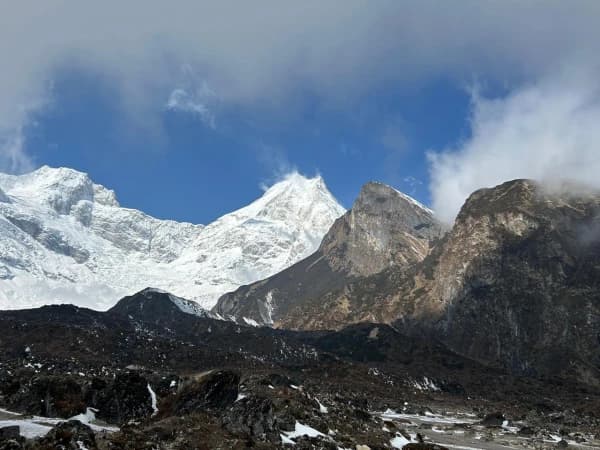
For trekkers who want more than a trail, Pisang Peak (6,091 metres) is accessible from Upper Pisang. The peak is one of Nepal's trekking peaks, climbable by experienced trekkers with basic mountaineering training rather than technical climbing expertise. The standard route involves a high camp at approximately 5,500 metres and a summit push that includes steep snow and an exposed ridge.
The Pisang Peak climb adds three to four days to the Circuit itinerary and requires an NMA climbing permit (approximately three hundred and fifty dollars in peak season). The summit provides views that the trail cannot, looking down on the Manang valley from six thousand metres, with the Annapurna range at eye level rather than above. For trekkers who want a summit push combined with the Circuit, Pisang Peak offers a less crowded alternative to Chulu West (which is more commonly attempted from the Circuit).
Does the upper Pisang trail help acclimatisation for Thorong La?
Pisang sits at 3,185-3,310 metres, the altitude zone where most trekkers begin to feel the effects of reduced oxygen. The walk from Chame (2,670 metres) to Pisang gains approximately 500-640 metres depending on whether you take the upper or lower trail. This is a significant daily altitude gain, and mild symptoms, headache, breathlessness on exertion, reduced appetite, are common on arrival.
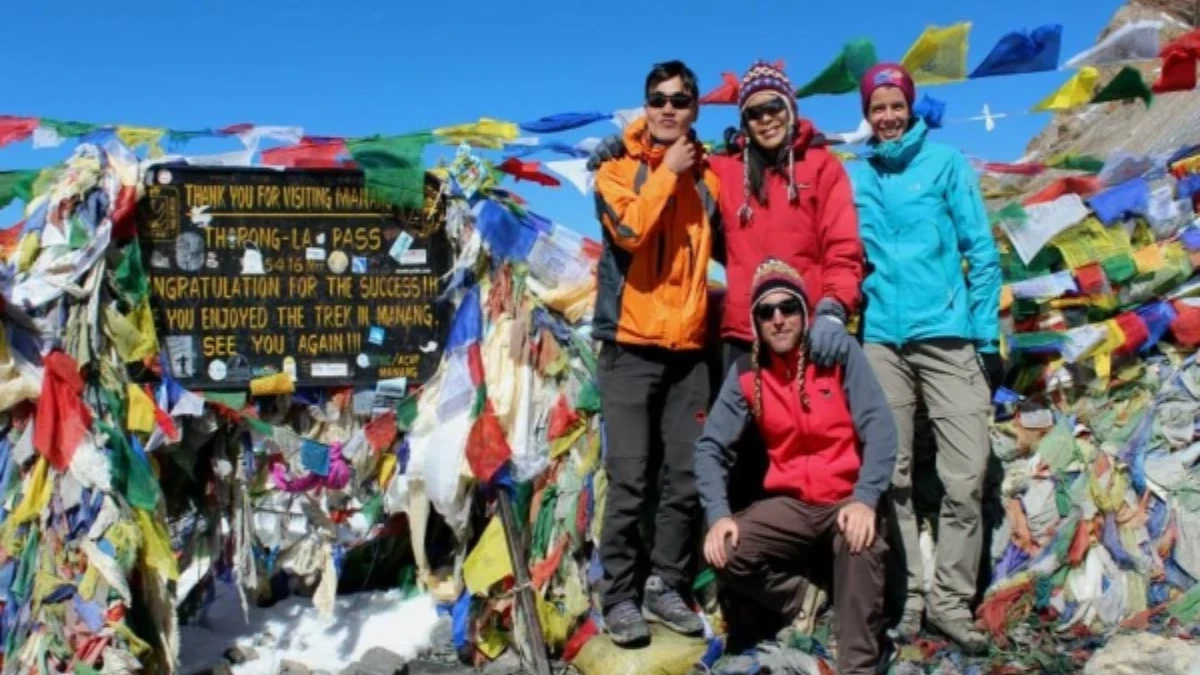
The acclimatisation benefit of taking the upper trail is measurable. Walking at 3,310 metres (Upper Pisang) versus 3,185 metres (Lower Pisang) exposes your body to 125 metres of additional altitude, a small difference that triggers slightly stronger adaptive responses. More importantly, the ridge walking between Upper Pisang and Ngawal (if you continue on the upper trail the next day) reaches 3,660 metres, three hundred metres higher than the lower trail's route to Manang. This additional altitude exposure improves acclimatisation for the push to Thorong La (5,416 metres) three to four days later.
What Do You Need to Know About Pisang?
Altitude: Lower Pisang 3,185m, Upper Pisang 3,310m.
Walking time from Chame: 4-5 hours (lower trail) or 5-6 hours (upper trail via Upper Pisang).
Accommodation: Lower Pisang has 5-6 teahouses. Upper Pisang has 2-3 smaller lodges. Most itineraries place the overnight at Lower Pisang with an optional side trip to Upper Pisang.
Best time: October-November (clear views, stable weather). March-May (warmer, hazier but rhododendrons at lower altitudes).
Should you take the upper or lower Pisang trail?
Every trek contains moments where the easy path and the rewarding path diverge. The Annapurna Circuit contains several, the lower trail versus the upper at Pisang, the standard route versus the Nar-Phu Valley detour, the direct path versus the Tilicho Lake side trip. At each divergence, the trekker chooses: convenience or experience. Speed or depth. The path that most people take or the path that rewards the few who do not.
At Pisang, the choice is small, three hundred metres of extra climbing, ninety minutes of extra walking. The reward is disproportionately large: a monastery on a ridge, a panorama that the valley floor hides, and the specific satisfaction of having climbed above the trail to see what the trail, from below, only suggests. The mountains do not care which path you take. But you will. And the trekker who chooses the upper trail at Pisang carries home a view, and a memory of the climb that earned it, that the trekker on the lower trail never receives.
Pisang sits on the Annapurna Circuit Trek and the Manaslu Circuit Trek trail junction area near Chame.
Pisang has two versions: Lower Pisang on the main trail and Upper Pisang on the ridge above. Take the upper trail. The monastery, the views, and the traditional Manang houses are all up there. Lower Pisang has the lodges and the easy walk. Upper Pisang has the experience. Your guide will offer you the choice. Choose up.
Pisang is on our Annapurna Circuit Trek. We take the upper trail.
WhatsApp:+977 9810351300
Email:[email protected]
Written by Shreejan Simkhada, CEO of The Everest Holiday and third-generation Himalayan guide. TAAN Member #1586.
Pisang is the Manaslu Circuit transition village. Our Manaslu Circuit Trek (12 Days) is private (your group only, no strangers), 2026 dates open, From USD $799. WhatsApp us for tailored 2026 dates and current departures.
Continue planning your trek
This is one stop on the Annapurna Circuit trail. For the full route, read our Annapurna Circuit cost and planning guide. When you are ready for dates and prices, see the Annapurna Circuit Trek (12 days) or WhatsApp us directly. We reply personally.



 Chat with Shreejan