

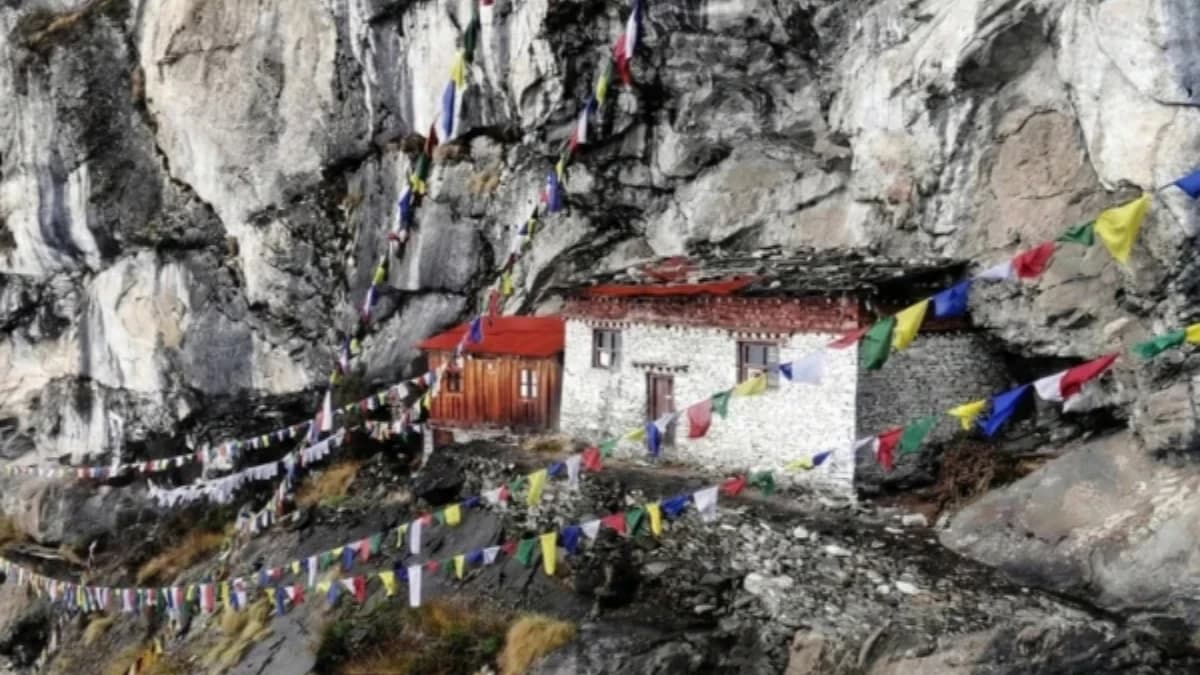
The cave is not much to look at. A shallow overhang in the cliff face, perhaps three metres deep, two metres high, the rock stained with the soot of butter lamps and the passage of centuries. Prayer flags are strung across the entrance. A small shrine, stones stacked, a faded photograph of a lama, a handful of wilted marigolds, sits inside. The floor is bare rock, cold to the touch, worn smooth by the bodies of meditators who have sat here for a thousand years.
This is Milarepa's Cave. One of dozens of caves across the Himalaya associated with Milarepa, the eleventh-century Tibetan poet, yogi, and saint who is the most beloved figure in Tibetan Buddhist folklore. Whether Milarepa himself actually meditated in this specific cave is a matter of faith rather than archaeology. What is not in dispute is that the cave has been a meditation site for centuries, that the local Buddhist communities of the Manaslu region consider it sacred, and that the trekkers who visit it, climbing fifteen minutes off the main Manaslu Circuit trail to sit in the cold, dim silence of a rock overhang at 3,500 metres, encounter something that the trail's panoramic mountain views do not provide: stillness.
Not the stillness of a quiet landscape. The Himalaya is never completely quiet: the wind, the ravens, the distant rumble of glaciers ensure that. But the stillness of a place where stillness has been practised. Where someone, Milarepa or his followers or the monks who came after, sat in this exact spot, closed their eyes, regulated their breathing, and sought to understand the nature of consciousness in a cave that the rest of the world had not yet discovered existed.
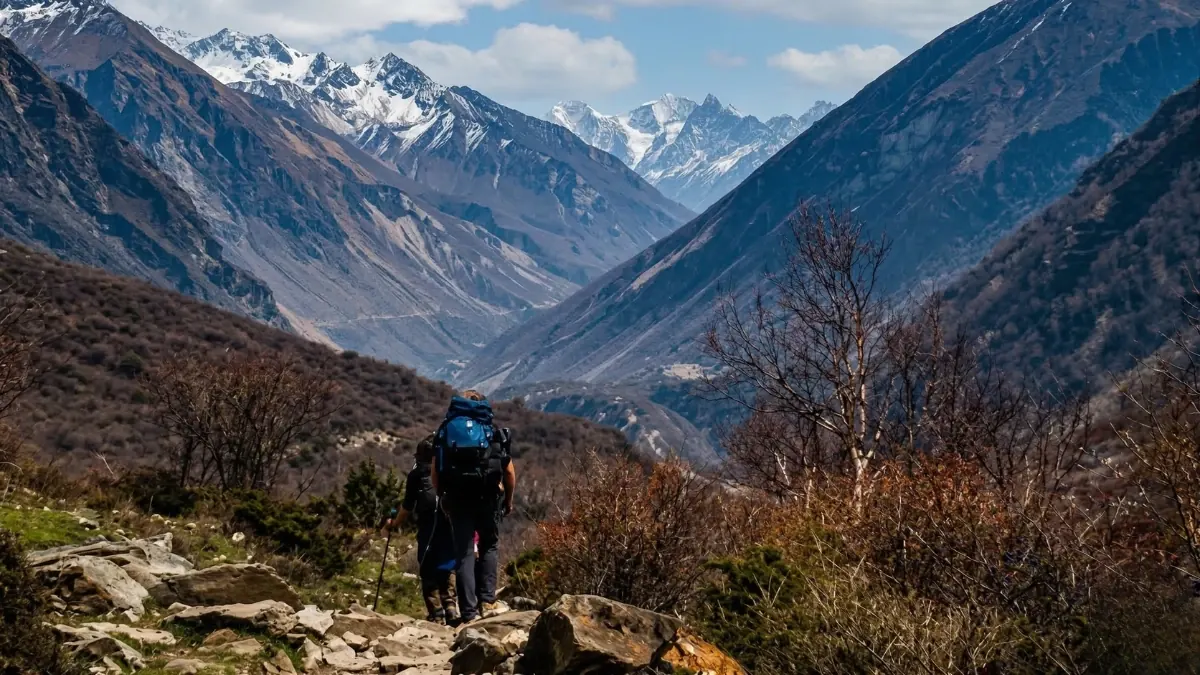
Milarepa's Cave at a glance
| Detail | Facts |
|---|---|
| What it is | A rock-overhang meditation cave linked to Milarepa, the 11th-century Tibetan poet, yogi and saint |
| Altitude | About 3,500 m |
| Where | On the Manaslu Circuit, within the Manaslu Conservation Area |
| Getting there | A short walk off the main trail, on the Manaslu Circuit and Tsum Valley trek |
| Nearby sacred sites | Mu Gompa and Rachen Gompa in the Tsum Valley, Pungyen Gompa above Samagaon |
| Our trek | The 19-day Tsum Valley & Manaslu Circuit or the 16-day Tsum Valley trek |
Who Was Milarepa and Why Does His Cave Matter?
Milarepa (1052-1135 CE) is Tibet's most famous yogi and the subject of one of the great spiritual biographies of world literature, "The Hundred Thousand Songs of Milarepa." His story is dramatic: born into wealth, orphaned, his family's property stolen by a treacherous uncle, young Milarepa learned black magic to take revenge, killing thirty-five people at his uncle's wedding through sorcery. Consumed by remorse, he sought redemption through Buddhist practice, becoming a student of Marpa the Translator, who subjected him to years of punishing physical labour before accepting him as a disciple.
After his training with Marpa, Milarepa retreated to the caves of the Himalaya, spending years in solitary meditation, surviving on nettle soup (which turned his skin green, according to tradition), and composing the songs and poems that would become foundational texts of Tibetan Buddhism. His songs, which address suffering, impermanence, the nature of mind, and the beauty of the mountain landscape, are sung and chanted in Tibetan Buddhist monasteries to this day.
Milarepa's significance in Himalayan culture cannot be overstated. He is the patron saint of meditators, the exemplar of the possibility of redemption through practice, and the figure who demonstrated that enlightenment does not require monastery walls, that a cave in the mountains, with nothing but rock and sky and the discipline of the mind, is sufficient. Every cave associated with Milarepa in the Himalaya is a pilgrimage site, and the caves on the Manaslu Circuit, there are several, of varying accessibility, are among the most visited.
The Cave on the Manaslu Circuit
The most accessible Milarepa's Cave on the Manaslu Circuit is located near the trail between Samagaon and Samdo, at approximately 3,500-3,600 metres. The exact location varies in different guidebooks and trail descriptions, there are multiple caves in the area attributed to Milarepa, but the most commonly visited is a short detour (fifteen to twenty minutes uphill) from the main trail.
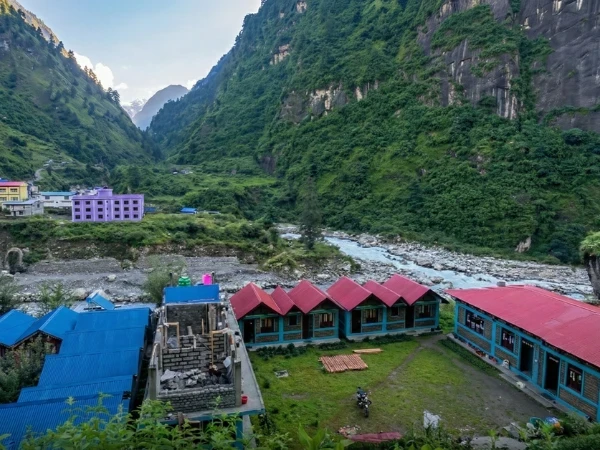
Your guide knows the location. If the cave is not explicitly on your itinerary, ask, most guides are happy to include the detour, which adds thirty to forty minutes to the day's walking and provides a cultural and spiritual experience that the main trail's mountain scenery does not.
The approach is a steep scramble up the hillside from the trail. The path is marked by cairns and prayer flags. The cliff face above holds the cave, and often, other smaller caves nearby that may also have been used for meditation. The main cave has the shrine, the butter lamp stains, and the specific atmosphere of a place that has been prayed in continuously for centuries.
What Is Inside Milarepa's Cave?
The cave interior is dark, cold, and quiet. The rock walls are blackened by centuries of butter lamp smoke. The floor is bare stone. The shrine at the back is modest, a few stones, some offerings, perhaps a photograph of the Dalai Lama or a local lama. There is no electricity, no signage, no visitor centre. The cave is exactly what it has always been: a rock shelter in the Himalaya where a person can sit, close their eyes, and be still.
If you sit in the cave, which you should, even for five minutes, the temperature drop is immediate. The rock retains the cold of the night and releases it slowly through the day. The sound changes too: the wind that is constant on the hillside outside falls silent inside the cave, and the specific acoustics of a small rock chamber create a quality of silence that open air does not possess. Your breathing becomes audible. Your heartbeat becomes audible. And the thoughts that the constant motion of trekking, walking, looking, photographing, eating, walking, keeps in the background suddenly move to the foreground.
This is what meditation caves are for. Not for escaping the world but for encountering the mind that the world's noise keeps hidden. Milarepa spent years in this encounter. The trekker who sits in the cave for five minutes gets a sample, a brief, cold, silent introduction to the practise that Milarepa mastered and that the cave has facilitated for a millennium.
What Other Sacred Sites Are Near the Cave?
The Manaslu Circuit passes through a landscape saturated with Buddhist sacred sites. The Milarepa cave is the most famous, but other sites add depth to the spiritual dimension of the trek.
Pungyen Gompa (Samagaon): The monastery above Samagaon village, with wall paintings and a resident community of monks. The morning prayers, audible from the village below, are one of the cultural highlights of the circuit.
Mu Gompa (Tsum Valley): For trekkers who include the Tsum Valley side trip, Mu Gompa at 3,700 metres is a monastery of extraordinary spiritual power, a community of Buddhist monks practising in isolation at the head of a sacred valley.
Mani walls throughout the circuit: The carved prayer stone walls that line the trail from Samagaon northward are among the longest and most elaborate in Nepal. Some stretch for hundreds of metres, continuous walls of carved stones, each inscribed with mantras, accumulated over centuries by the devotion of the communities through which the trail passes.
Larkya La prayer flags: The pass at 5,160 metres, the circuit's highest point, is marked by a dense accumulation of prayer flags that represent decades of devotion by trekkers, guides, and monks. Standing at the pass among the flags, hearing them snap in the wind that scours the ridge, is a spiritual thing regardless of the trekker's religious belief.
Visiting Respectfully
The cave is a sacred site, not a tourist attraction. Behaviour that is appropriate in a museum, touching objects, taking flash photographs, speaking loudly, is not appropriate here. Enter quietly. Do not touch the shrine or the offerings. Do not remove anything, not a stone, not a prayer flag, not a piece of the cave wall. Photographs are acceptable but flash is not. And if you sit to meditate, even briefly, sit respectfully, facing the shrine, in silence.
A small offering is customary. A few rupees placed at the shrine. A kata (white ceremonial scarf) if you have one. Or simply the offering of presence, the act of visiting, of paying attention, of acknowledging that this cave holds something that the mountain views outside do not contain.
The Practise of the Cave
Milarepa sat in caves because caves provide what the external world does not: containment. The mountain landscape is vast, open, and perpetually in motion, clouds, wind, light, shadow. The cave is small, enclosed, and still. The meditator who sits in the cave exchanges the infinite for the intimate, the spectacular for the specific, the endless visual stimulation of the Himalaya for the darkness, the cold, and the sound of their own breathing in a rock chamber that has not changed in a thousand years.
You do not need to be Buddhist to understand this exchange. You do not need to meditate to feel the cave's quality of stillness. You need only to sit, on cold rock, in dim light, with the mountain wind silenced by the cave walls and the mountain views replaced by darkness, and notice what the silence contains. Not nothing. Something. The specific, persistent, quietly startling awareness that you are here, in this body, breathing this air, in a cave where people have been sitting for a thousand years, and that the awareness itself, not the view, not the summit, not the photograph, is the point.
Milarepa knew this. The cave taught him. And the cave, unchanged by the centuries that have passed since he sat here, is willing to teach you, in five minutes, in fifteen, in whatever time you give it, the same lesson. Not enlightenment. Not satori. Not nirvana. Just stillness. The specific, personal, irreducible experience of sitting still in a place that has been still for a very long time, in mountains that have been here for fifty million years, and understanding, briefly, physically, in the cold and the dark, that stillness is not the absence of experience but the deepest form of it.
Milarepa Cave is a stop on the Tsum Valley Trek (16 days). The cave can also be visited on the combined Tsum Valley and Manaslu Circuit.
Milarepa's Cave is one of those places that makes rational people go quiet. I have seen trekkers who do not believe in anything sit inside the cave and stay for twenty minutes without speaking. There is something about the darkness, the incense smoke, and the knowledge that a man meditated here for years with nothing but nettle soup and determination.
The cave is on the Tsum Valley trek, one of Nepal's most sacred and least visited routes. We handle all the restricted area permits.
WhatsApp:+977 9810351300
Email:[email protected]
Written by Shreejan Simkhada, CEO of The Everest Holiday and third-generation Himalayan guide. TAAN Member #1586.
Milarepa's Cave is the spiritual highlight of Tsum Valley. Our Tsum Valley & Manaslu Circuit Trek (19 Days) is private (your group only, no strangers), 2027 dates open, From USD $1499. WhatsApp us for tailored 2027 dates and current departures.
 Chat with Shreejan