
Written by Shreejan Simkhada, CEO of The Everest Holiday and third-generation Himalayan guide. TAAN Member #1586.
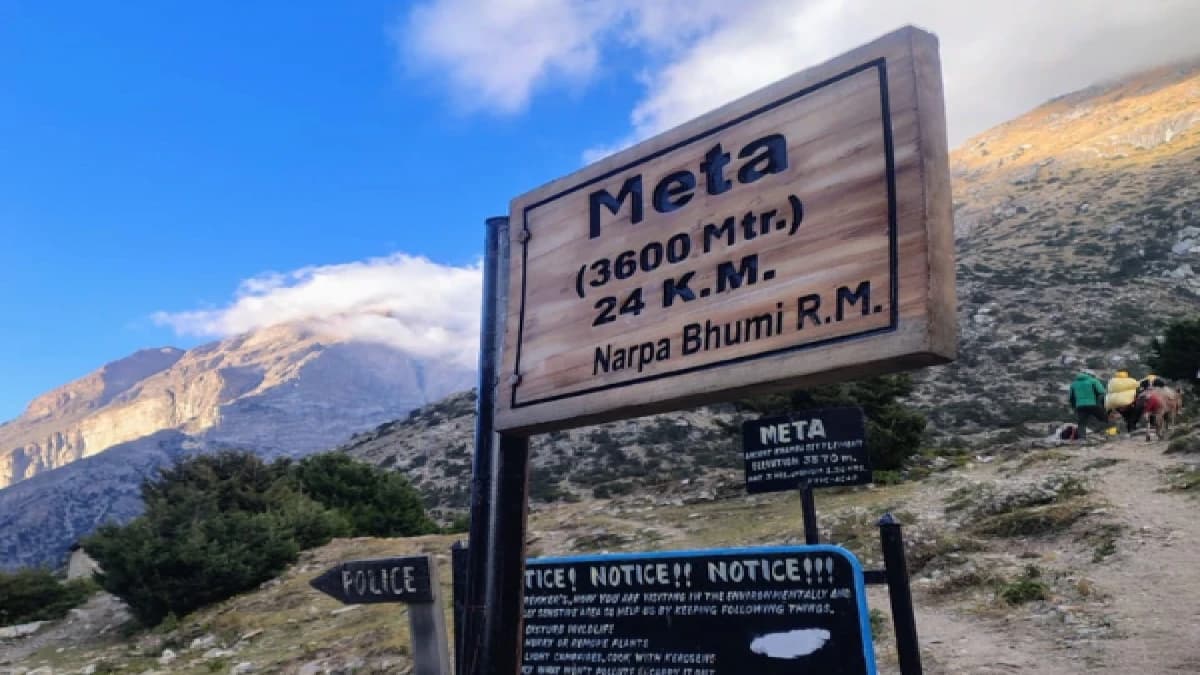
Meta is the first settlement in the Nar Phu valley, a semi-hidden Tibetan-Buddhist enclave in the far north of Manang district. It sits at roughly 3,560 metres, and you reach it not from the Manaslu side but by turning north off the Annapurna Circuit at Koto, climbing all day up the tight Phu Khola gorge into a restricted valley that only opened to trekkers in 2003. If you are researching the Nar Phu Valley Trek, Meta is where the valley first shows itself.
Meta at a glance
| Detail | Fact |
|---|---|
| Altitude | approx. 3,560 m |
| Region / district | Nar Phu valley, Manang district (Annapurna Conservation Area) |
| How you get there | North from Koto (2,600 m) on the Annapurna Circuit, up the Phu Khola gorge |
| What comes next | Kyang, then Phu village (4,080 m); Nar village (4,110 m) via Nar Phedi |
| Permit | Nar Phu Restricted Area Permit: US$100/week Sep–Nov, US$75/week Dec–Aug, plus ACAP |
| Best season | Late September to November, and March to May |
Where Meta actually is
This matters, because Meta is easy to confuse. It is not on the Manaslu Circuit and it has nothing to do with the Budhi Gandaki gorge. Meta belongs to the Nar Phu valley, a side valley that branches north from the Annapurna Circuit at the village of Koto, a short distance beyond Chame. Most trekkers walk the Annapurna Circuit for years without ever knowing the turning is there. You leave the main trail, cross into a narrow gorge cut by the Phu Khola, and climb through pine and juniper for the better part of a day. Meta is where that climb finally levels out and the valley opens.
The valley was a restricted area closed to foreigners until 2003, and it still requires a special permit and a licensed guide. That is exactly why it has stayed as it is: a Tibetan-Buddhist world of stone villages, mani walls, chortens and yak pasture that feels a century removed from the teahouse traffic on the Annapurna Circuit a day's walk below.
What Meta is like
Meta is a small, spread-out herding settlement rather than a dense village. The people are of Tibetan and Khampa descent, and the houses are the flat-roofed stone kind you see across the high Trans-Himalaya, not the timber lodges of the lower valleys. It is used seasonally by families from Nar and Phu who move their yaks and horses between pastures, so how busy it feels depends entirely on the time of year.
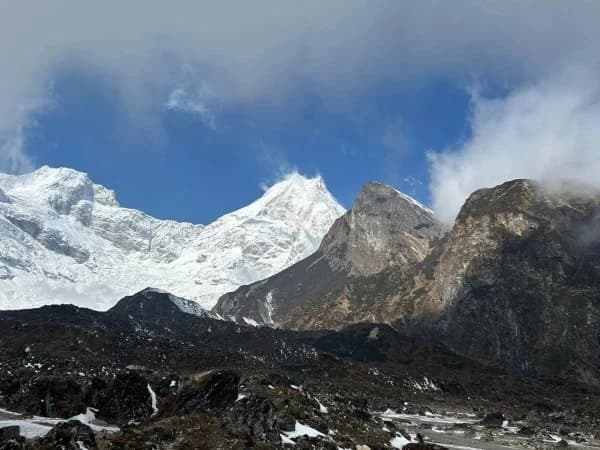
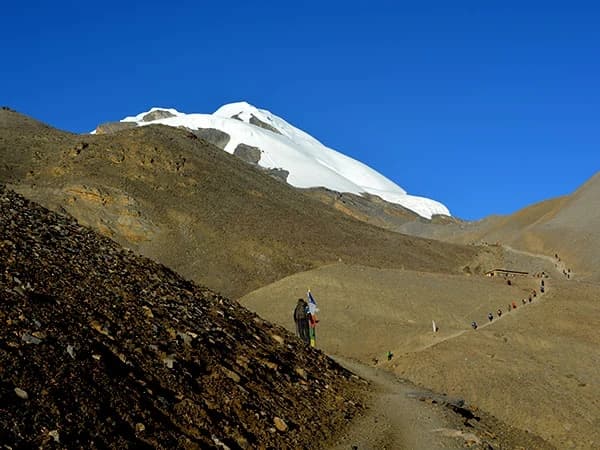
What you notice first is the openness. After a day walled inside the gorge, Meta gives you a real horizon again: Pisang Peak and the shoulders of Annapurna II to the south, Kang Guru and Lamjung Himal along the ridgelines, and the dry, wind-scoured light of the high country. There are a couple of basic teahouses with a common stove, plain rooms, dal bhat and Tibetan thukpa. Sleeping here at 3,560 metres is also good acclimatisation before the trail climbs on towards Phu and, eventually, the Kang La pass at 5,320 metres.
Meta on the Nar Phu Valley Trek
On our Nar Phu Valley Trek, Meta is usually the first night inside the restricted valley, after the long climb from Koto. From here the route continues deeper: to Kyang, the old winter settlement, and up to Phu village at 4,080 metres beneath its ancient gompa. The trek then crosses to Nar village by way of the Nar Phedi monastery, and finally climbs over the Kang La to rejoin the Annapurna Circuit at Ngawal. If you want the geography of the whole approach, the gateway village at the mouth of the valley is Koto.
Do you need a permit for Meta?
Yes. Meta lies inside the Nar Phu restricted area, so you need a Nar Phu Restricted Area Permit, which costs US$100 per week in the September–November season and US$75 per week from December to August, with a further US$15 per day beyond the week. You also need the standard Annapurna Conservation Area permit. Restricted-area rules mean you must travel with a licensed guide arranged through a registered agency; since March 2026 a solo trekker can be issued the permit, but one guide can cover no more than seven trekkers. These figures are set by Nepal's Department of Immigration, whose current restricted-area schedule is published at immigration.gov.np.
When to go
The Nar Phu valley is at its best from late September to November and again from March to May. Being in the rain shadow behind the main Annapurna wall, it stays drier than the southern valleys, but the nights are cold and Meta at 3,560 metres already sits well above the tree line's comfort. Winter is hard and many of the seasonal families have moved down. October and October's clear, stable weather is the classic window.
Plan your trek to Meta and the Nar Phu valley
Meta is the doorway into the Nar Phu hidden valley. Our Nar Phu Valley Trek is private (your group only, no strangers), with 2027 dates open, from USD $1,210 per person. WhatsApp us and I will help you plan it honestly. We reply personally.
WhatsApp: +977 9810351300
Email: [email protected]
Shreejan Simkhada is the CEO and co-founder of The Everest Holiday, a family-run trekking company in Kathmandu, and a third-generation Himalayan guide. TAAN Member #1586. Every booking helps fund our Nagarjun Learning Center.
 Chat with Shreejan