

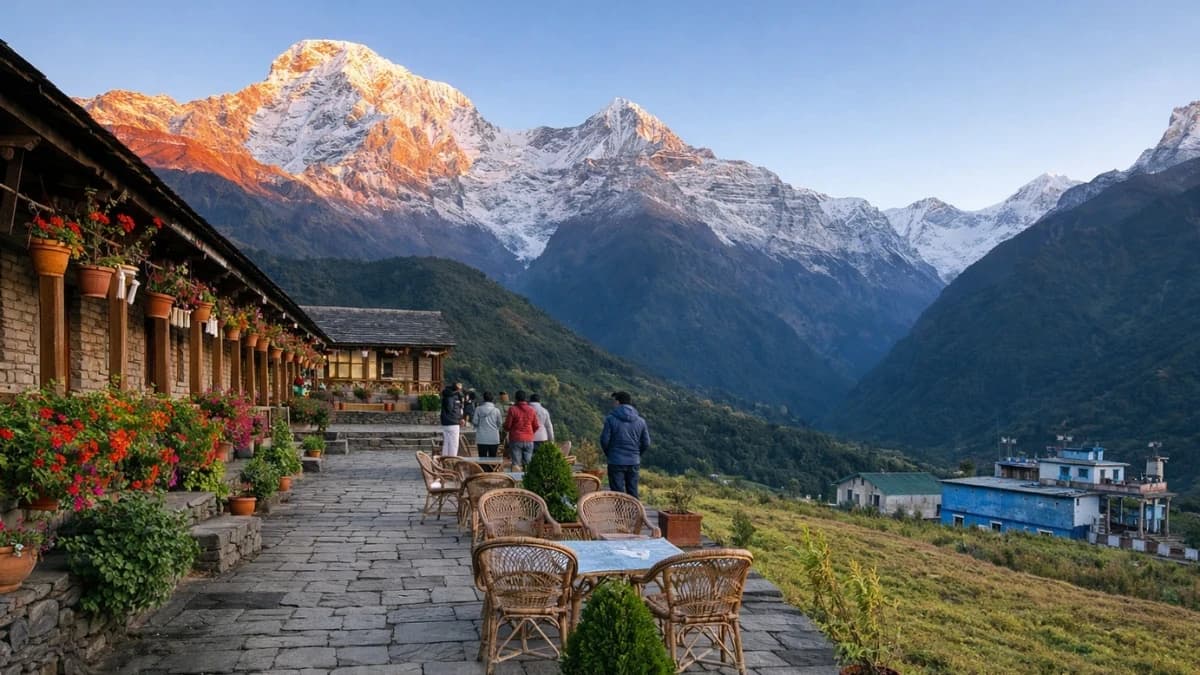
Short answer: Ghandruk (1,940 m) is the largest Gurung village in Nepal, on a ridge above the Modi Khola facing Annapurna South and Machhapuchhre, and a stop on both the Annapurna Base Camp and Poon Hill treks. It is known for its stone houses, terraced fields and Gurung culture, and you can reach it from Pokhara by road and a short walk. Stay there on our Annapurna Base Camp trek.
The stone steps leading into Ghandruk number in the hundreds (steep, uneven, worn smooth by generations of bare feet and trekking boots), and by the time you reach the village centre your thighs are burning and your breathing is hard. Then you look up. Annapurna South fills the northern sky, its seven-thousand-metre summit so close and so white that it seems to be falling toward you. Machhapuchhre (the Fish Tail, sacred and unclimbed) rises to the northeast in its perfect pyramid shape. And below you, the terraced fields of the Gurung homeland cascade down the hillside in emerald steps that catch the afternoon light and hold it like water in shallow pools.
Ghandruk is not on the way to anywhere. It is a destination. The largest Gurung village in Nepal, sitting at 1,940 metres on a ridge above the Modi Khola river, it is the cultural capital of the Gurung people and one of the most beautiful villages in the Himalaya. Trekkers on the Annapurna Base Camp route and the Ghorepani-Poon Hill circuit pass through Ghandruk, but the village was here for centuries before either trail was marked, and the life that continues within its stone walls: the farming, the festivals, the military traditions, the weaving, predates and transcends its role as a trekking stop.
What Is Ghandruk Village Like?
Ghandruk is built on a south-facing hillside, which means it receives maximum sunlight and has views that face the Annapurna range head-on. The houses are traditional Gurung construction: stone walls, slate roofs, small windows, and wooden balconies where women sit in the afternoon spinning wool or sorting grain. The paths between the houses are paved with flat stones, worn to a polished sheen by centuries of use.
The village is large enough to feel like a small town, several hundred houses spread across the hillside, with a school, a health post, the Gurung Museum, a handful of shops selling basic goods, and a growing number of teahouses and lodges that serve the trekking trade. But it is small enough to walk across in twenty minutes, and the paths between the houses are narrow enough that you can hear conversations through open windows and smell cooking through kitchen doors.
The Gurung Museum, operated by the local community, is a small but well-curated collection of traditional Gurung artefacts, clothing, tools, weapons, religious objects, and photographs that document the village's history from pre-trekking isolation to its current dual existence as a farming community and trekking destination. The museum takes thirty to forty-five minutes to visit and provides context that transforms the village from a scenic stop into a cultural immersion. Entry is free or by donation.
What Is Gurung Culture Like in Ghandruk?
Ghandruk is the place to understand Gurung culture, not from a book or a museum panel but from the village itself, which is a living expression of traditions that have survived colonialism, modernisation, and globalisation without losing their essential character.
The houses face south and are built in terraces up the hillside, a design that maximises winter sun exposure and minimises exposure to the cold north wind. The ground floor is for animals (buffalo, goats). The first floor is the kitchen and living area. The attic stores grain and dried food. This vertical arrangement, animals below, humans in the middle, food above, has remained unchanged for centuries because it works: the animals provide warmth that rises to the living floor, and the grain stays dry and cool in the attic.
The women of Ghandruk are often more visible than the men. Many Gurung men serve in the British or Indian Gurkha regiments, spending years or decades abroad and returning with pensions that fund village improvements. The women manage the farms, raise the children, maintain the houses, and, increasingly, run the trekking lodges. The competence and warmth of the Gurung women who manage Ghandruk's teahouses is remarked upon by almost every trekker who stays.
If you visit during a festival, Dashain (October), Tihar (November), or the Gurung New Year (Tamu Lhosar, typically December-January), you will see the village transformed. The houses are decorated. Families gather from across the region. Traditional dances, the ghatu, performed by women in trance states, and the sorathi, a social dance for men and women, are performed in the village centre. And the food, sel roti (ring-shaped fried bread), gundruk (fermented leafy greens), millet beer (tongba), appears in quantities that suggest the entire village has been cooking for days, which it has.
Which Treks Pass Through Ghandruk?
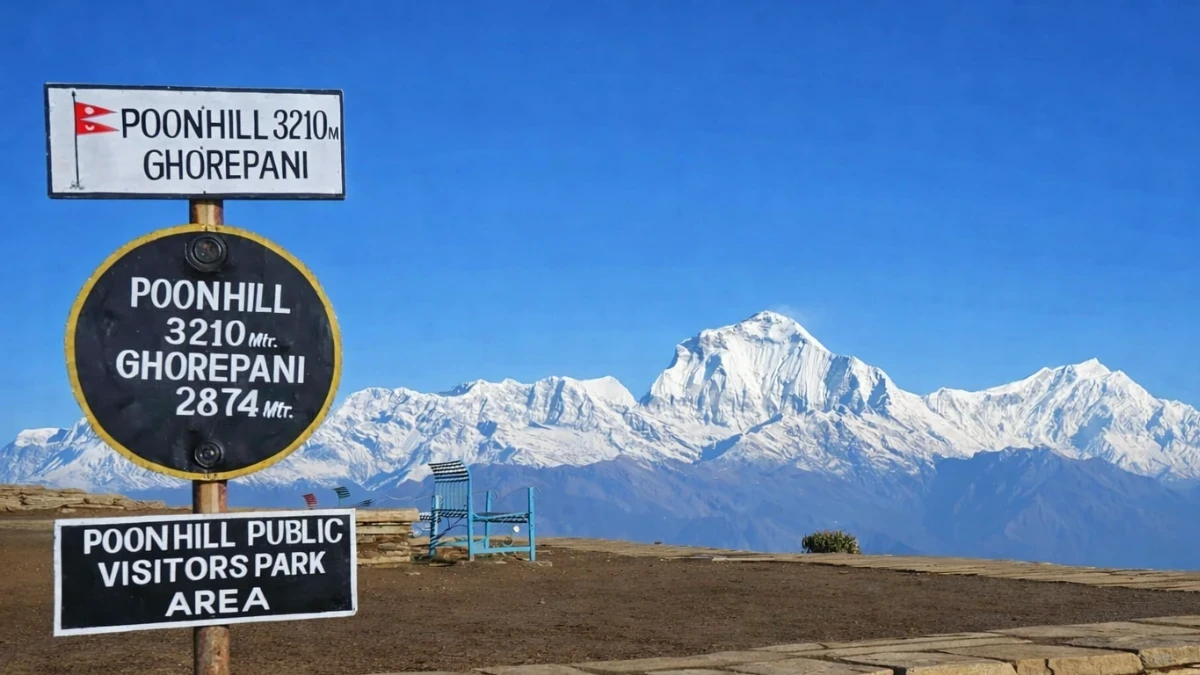
Ghandruk sits at a trail junction. The path north leads to Chhomrong and the Annapurna Sanctuary, the ABC trek. The path east leads to Landruk, Tolka, and eventually to the road at Nayapul or Birethanti. The path west crosses the Modi Khola and climbs to Tadapani and Ghorepani, the Poon Hill circuit. This junction makes Ghandruk a natural hub for multiple treks and a starting or ending point for shorter walks.
The most popular short trek involving Ghandruk is the Ghandruk Loop, a three-to-four-day walk from Nayapul to Ghandruk, across to Landruk, and back to Nayapul. This loop offers mountain views, Gurung culture, and moderate walking without the altitude challenges of the ABC or Poon Hill routes. It is ideal for families, first-time trekkers, or travellers with limited time who want a genuine Himalayan village experience.
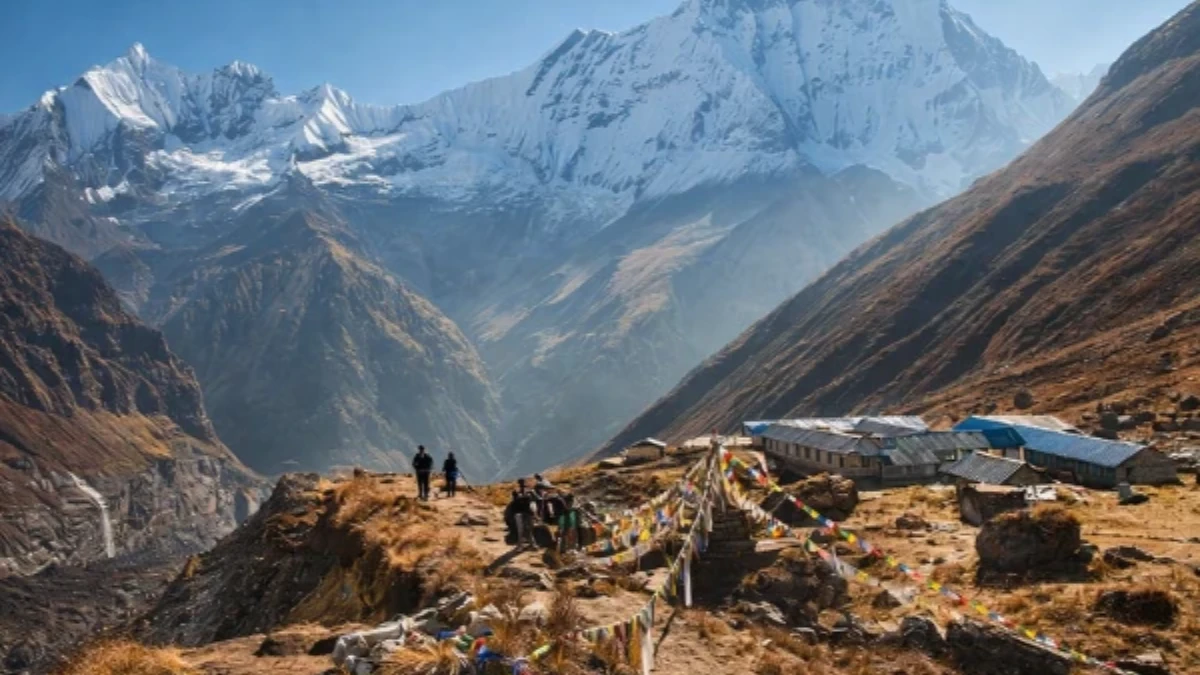
For ABC trekkers, Ghandruk is typically Day 1 or Day 2, the entry point to the Annapurna Sanctuary trail. The walk from Nayapul to Ghandruk takes four to five hours and gains approximately 1,000 metres of altitude, mostly on stone steps. It is the steepest sustained climb of the ABC trek's lower section, and many trekkers arrive in Ghandruk with legs that are already questioning the wisdom of the entire enterprise. The teahouse, the tea, the sunset over Annapurna South, and the comfort of a warm dal bhat restore both legs and wisdom by evening.
Where to Stay in Ghandruk
Ghandruk has over twenty lodges ranging from basic to comfortable. The village's popularity means that rooms are generally available even in peak season, though the best lodges fill early.
Lodges in Upper Ghandruk (near the museum and the traditional village centre) offer more authentic settings, older buildings, narrower paths, closer proximity to Gurung family life. Lodges in Lower Ghandruk (near the trail junction and the newer part of the village) are often newer and slightly more spacious.
Most lodges have rooms with mountain views. Some have gardens. All serve the standard trekking menu plus, in Ghandruk's case, some Gurung specialties, gundruk ko jhol (fermented greens soup), dhindo (millet porridge), and, if you are lucky and your host is generous, local raksi (millet spirit) after dinner.
What Do You Need to Know Before Visiting Ghandruk?
Altitude: 1,940 metres. No altitude sickness risk for most trekkers.
Walking times: four to five hours from Nayapul/Birethanti (steep climb). Three to four hours to Chhomrong (undulating trail with river crossing). Four to five hours to Tadapani (climb through forest).
Permits: ACAP permit required, NPR 3,000 for foreign nationals and NPR 1,000 for SAARC nationals, roughly twenty and seven US dollars. Checked at the ACAP checkpoint before Ghandruk.
Facilities: electricity (charging available), basic Wi-Fi at some lodges, mobile coverage (Ncell and NTC), two small shops, Gurung Museum, health post.
Best time to visit: October-November (clear skies, Dashain/Tihar festivals). March-April (rhododendron bloom, warmer). December-February (cold but clear, very quiet).
What Is the Sunset View Like from Ghandruk?
There is a flat rock at the top of Ghandruk, every guide knows it, and most will take you there if you ask, from which the sunset view is the finest in the Annapurna foothills. Annapurna South and Hiunchuli catch the last light. Machhapuchhre turns from white to gold to pink to purple in a sequence that takes twenty minutes and that no two sunsets repeat identically. The valley below fills with shadow while the peaks above burn with the day's final energy. And the village, smoke rising from kitchen chimneys, prayer flags catching the last breeze, children's voices carrying up the hillside, settles into evening with the unhurried confidence of a community that has watched this sunset every day for five hundred years and has no reason to believe it will not watch it again tomorrow.
This is Ghandruk. Not a stop on the way to Annapurna Base Camp, though it is that. Not a museum of Gurung culture, though it contains one. But a village, alive, working, cooking, praying, farming, hosting, that happens to sit in one of the most beautiful positions on earth, with mountains that most people only see in photographs visible from every doorway, and a culture so deep and so warm that the stone steps you cursed on the way up feel, by evening, like the price of admission to something worth far more than the effort they cost.
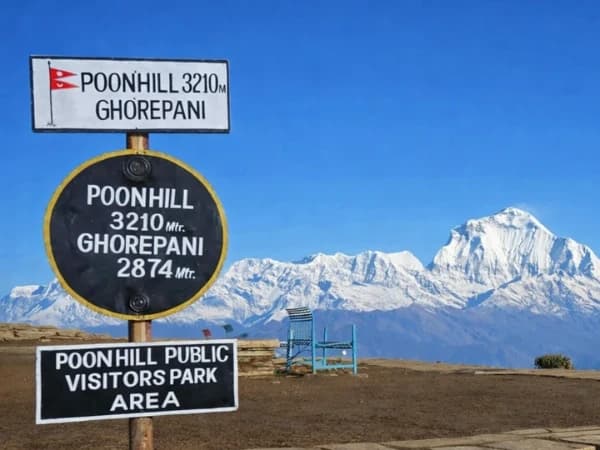
Ghandruk is on the trail to Annapurna Base Camp and also the starting point for the Poon Hill Trek. Both routes pass through this village, giving you a chance to experience Gurung culture before heading higher into the mountains.
Ghandruk is the Gurung heartland. The stone houses, the terraced fields, the museum that tells the story of Gurkha soldiers and mountain farmers: this is the cultural core of the Annapurna region. The views of Annapurna South and Machhapuchhre from the village edge are some of the best in Nepal, and the dal bhat at the lodges here is cooked by Gurung grandmothers who have been feeding trekkers for thirty years.
Ghandruk is on our Annapurna Base Camp Trek and the Poon Hill Trek.
WhatsApp:+977 9810351300
Email:[email protected]
Written by Shreejan Simkhada, CEO of The Everest Holiday and third-generation Himalayan guide. TAAN Member #1586.
Ghandruk is the cultural heart of Annapurna foothills. Our Annapurna Base Camp Trek (9 Days) is private (your group only, no strangers), 2027 dates open, From USD $725. WhatsApp us for tailored 2027 dates and current departures.

 Chat with Shreejan