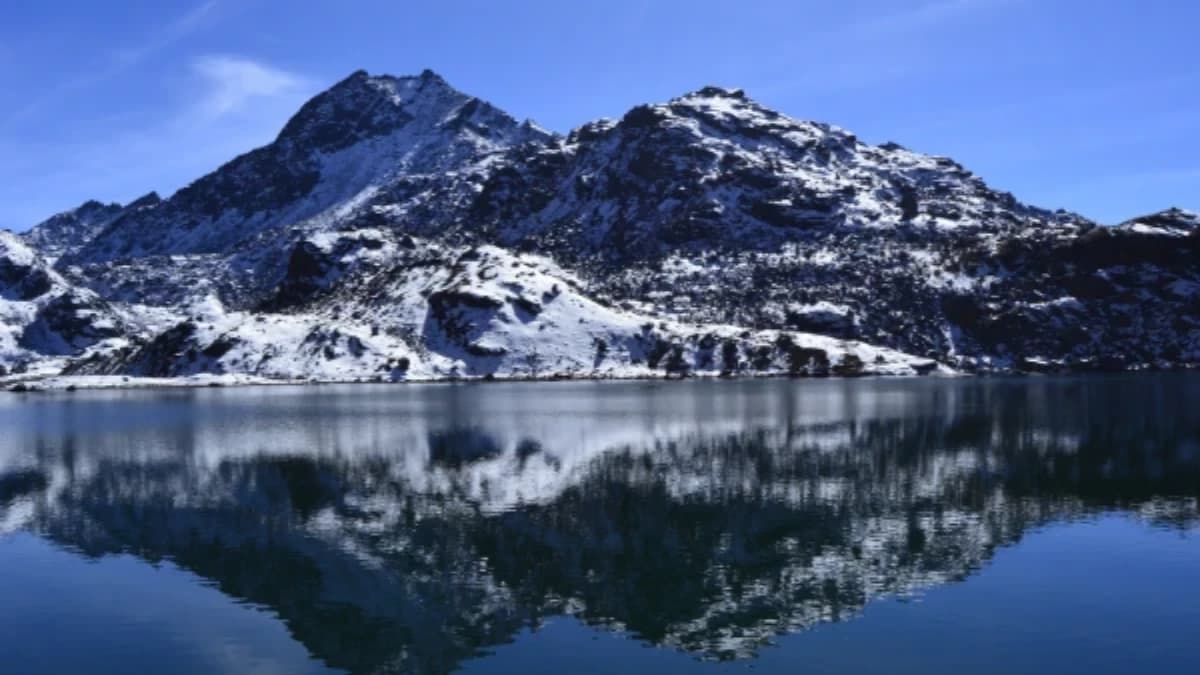
The lake appears without warning. You have been climbing for two days through rhododendron forest, across alpine meadow, and over rocky terrain that gets progressively barer and colder with each hundred metres gained. The trail crests a ridge at 4,380 metres, your lungs are protesting the altitude, your legs are heavy from six hours of uphill , and then the ridge drops away and the lake is there. Not a pond. Not a puddle. A genuine alpine lake, roughly three hundred metres across, sitting in a rocky basin surrounded by peaks that rise another thousand metres above the waterline. The water is dark blue , almost black in the shadow of the surrounding ridges, turning to deep sapphire where the sun reaches it. Prayer flags on the shore snap in the wind. A small Hindu shrine sits on a rock promontory. And the silence , the absolute, ringing, altitude-enforced silence of 4,380 metres , makes the scene feel less like a landscape and more like a painting that someone forgot to put in a frame.
Gosaikunda is one of Nepal's most sacred lakes , holy to both Hindus and Buddhists, visited by thousands of pilgrims during the Janai Purnima festival in August, and revered in Hindu mythology as the lake created by Lord Shiva's trident when he struck the mountainside to create water after being poisoned during the churning of the cosmic ocean. The mythology is ancient. The lake is real. And the experience of standing on its shore, at an altitude where breathing requires conscious effort and thinking requires conscious patience, blends the sacred and the physical in a way that Nepal does better than anywhere on earth.
The Trek
Gosaikunda sits in Langtang National Park, north of Kathmandu, accessible by a trek of three to five days from either Dhunche (the park entrance) or Sundarijal (on the rim of the Kathmandu Valley). The trek can be done as a standalone destination or combined with the Langtang Valley trek and the Helambu trek for a comprehensive two-to-three-week circuit of the Langtang region.
From Dhunche (the standard approach): The trail climbs from Dhunche (1,960 metres) through dense forest to Sing Gompa (3,330 metres) on the first day, then continues upward through diminishing vegetation to the lake at 4,380 metres on the second day. Total walking time: approximately ten to twelve hours over two days. The altitude gain is significant , 2,420 metres in two days , and acclimatisation is a genuine concern. Some trekkers add a night at Chandanbari (3,270 metres) between Dhunche and Sing Gompa to slow the ascent.
From Sundarijal (via Helambu): A longer approach that starts on the rim of the Kathmandu Valley, crosses through Helambu (the highland Tamang region), and approaches Gosaikunda from the east via the Laurebina La pass (4,610 metres). This approach takes five to seven days and provides better acclimatisation because the altitude gain is more gradual. The Helambu section adds cultural richness , Tamang villages, monasteries, and terraced farmland , that the direct Dhunche approach lacks.
Difficulty: Moderate to challenging. The altitude is serious , 4,380 metres at the lake, 4,610 metres at Laurebina La if crossing to Helambu. The trail is well-maintained but steep in sections. No technical terrain. The main challenge is altitude , trekkers who ascend too fast from Dhunche risk AMS.
The Sacred Lakes
Gosaikunda is not a single lake but a system of over a hundred alpine lakes scattered across the high basin between 4,000 and 4,600 metres. The main lakes , Saraswati Kunda, Bhairav Kunda, and Gosaikunda itself , are the largest and most sacred, but dozens of smaller lakes dot the landscape, some no larger than a pond, others significant bodies of water that reflect the peaks above with a clarity that still air and clean water produce at altitude.
Gosaikunda (4,380 metres) is the main lake , the largest, the most sacred, and the one that draws the pilgrims. Hindu mythology places the creation of the lake in the Samudra Manthan (churning of the ocean), when Lord Shiva consumed the poison that emerged and, burning with its heat, struck the mountainside with his trident to create water for relief. The three main lakes are said to represent Brahma (Saraswati Kunda), Vishnu (Bhairav Kunda), and Shiva (Gosaikunda). A rock formation in the centre of Gosaikunda lake is said to resemble Shiva's trident, and pilgrims circumambulate the lake, praying and making offerings at the shrine on the shore.
Janai Purnima: On the full moon of August (the exact date varies with the lunar calendar), thousands of Hindu pilgrims trek to Gosaikunda for the Janai Purnima festival. Devotees bathe in the sacred water , despite its near-freezing temperature , and replace the janai (sacred thread) that marks their religious identity. The festival transforms the normally empty lake shore into a tent city of pilgrims, sadhus (holy men), and festival vendors. The atmosphere is intensely devotional , chanting, incense, the sound of conch shells echoing off the basin walls , and the sight of thousands of people gathered at 4,380 metres for a religious purpose that predates any of the trekking trails by centuries is one of the most powerful cultural experiences in Nepal.
The Landscape
The Gosaikunda basin is alpine desert , above the tree line, beyond the grass line, in the zone where only lichen, moss, and the hardiest alpine plants survive. The rocks are grey and ochre, sculpted by freeze-thaw cycles into angular shapes that make the landscape look geological rather than ecological. Snow covers the higher ridges from November to March, and the lakes themselves freeze partially or completely in winter , the ice forming patterns of fracture and clarity that change daily with the temperature.
The peaks surrounding the basin are not named-brand mountains , no eight-thousanders, no famous climbs. But their proximity and their steepness create a sense of enclosure that is more intimate than the panoramic views of the Everest or Annapurna regions. You are inside the mountains, not looking at them from a distance. The peaks rise directly from the lake shore, and the relationship between water and rock , between the dark, still surface of the lake and the grey, angular walls above , is the landscape's primary visual element.
On clear mornings, the lake reflects the peaks with a fidelity that makes the reflection indistinguishable from the reality. The air at 4,380 metres is thin, dry, and extraordinarily clear , the UV intensity burns exposed skin within minutes, and the light has a quality of sharpness that lower altitudes cannot produce. Photographs taken at Gosaikunda have a hyper-real quality , the colours are saturated, the contrast is extreme, and the sky is a blue so deep it approaches violet.
Where to Stay
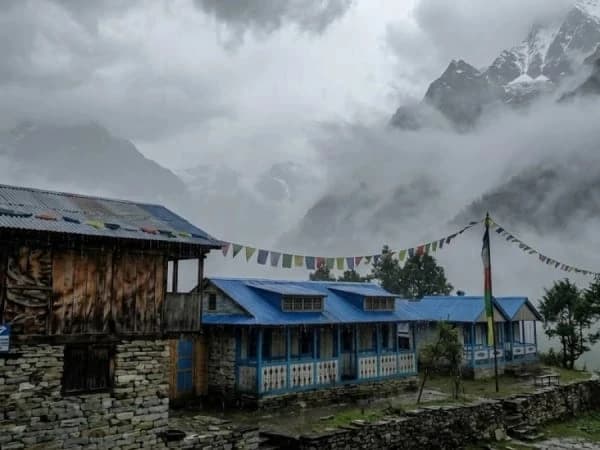
Gosaikunda has two or three teahouses on the lake shore. They are basic , stone walls, tin roofs, small rooms with two beds, shared bathroom, common room with a stove. The altitude means the nights are cold (minus ten to minus fifteen in October), the food is limited (dal bhat, noodle soup, tea), and the creature comforts are minimal.
Sing Gompa (3,330 metres), one day below the lake, has more comfortable teahouses and is a common overnight stop for trekkers ascending from Dhunche. The cheese factory at Sing Gompa , established decades ago as a Swiss development project , produces yak cheese that is available at the teahouses. The cheese is good , sharp, firm, different from anything you have tasted at lower altitude , and the cheese omelette at Sing Gompa is one of the small pleasures of the Gosaikunda trail.
Combining Gosaikunda
Gosaikunda works as a standalone three-to-five-day trek from Kathmandu , the closest high-altitude sacred lake experience available from the capital. But it reaches its full potential when combined with other Langtang region treks.
Gosaikunda + Langtang Valley: The most popular combination. Trek to Gosaikunda from Dhunche (two to three days), cross Laurebina La to Helambu (one day), and then either return to Kathmandu via Helambu or loop back to the Langtang Valley trail. Total: twelve to sixteen days. This combination delivers the sacred lake, the Langtang Valley's mountain scenery, and the Tamang cultural experience of Helambu in a single trek.
Gosaikunda + Helambu: A circuit that starts from Sundarijal (on the Kathmandu Valley rim), treks through the Helambu Tamang villages, crosses Laurebina La to Gosaikunda, and descends to Dhunche. Total: seven to ten days. This circuit is entirely within Langtang National Park and provides excellent cultural and natural diversity without extreme altitude (maximum 4,610 metres at the pass).
Practical Information
Altitude: 4,380 metres (Gosaikunda Lake), 4,610 metres (Laurebina La pass). Acclimatisation is essential , do not ascend from Dhunche to Gosaikunda in a single day.
Permits: Langtang National Park entry permit (approximately thirty-four to sixty-eight dollars depending on nationality) plus TIMS card. No restricted area permit needed.
Best season: October-November (clear skies, cold nights), March-May (warmer, less clear). August for Janai Purnima festival (crowded with pilgrims but culturally extraordinary).
Access: Dhunche is seven to eight hours by road from Kathmandu. Buses depart daily from Kathmandu's Machhapokhari bus park. Private vehicles are also available.
Duration: Three to five days for Gosaikunda alone. Seven to sixteen days for combined treks.
The Sacred and the Physical
Gosaikunda exists in two registers simultaneously. In the physical register, it is a high-altitude glacial lake in a rocky basin , beautiful, cold, and explainable by geology. In the sacred register, it is the lake that Lord Shiva created with his trident , holy, eternal, and explainable only by faith. The trekker who stands on its shore inhabits both registers at once , breathing the thin air of 4,380 metres while standing where pilgrims have stood for centuries, looking at water that is simultaneously H2O and holy.
This duality is Nepal's gift. Not just at Gosaikunda but everywhere , at every temple, every monastery, every sacred tree and carved stone along every trail. The physical and the sacred coexist without contradiction. The lake is deep because glaciers carved the basin. The lake is holy because Shiva struck the rock. Both are true. Both shape the experience of standing on the shore at dawn, watching the first light touch the water and the peaks, breathing air that is barely enough, and feeling , in the thin, cold, luminous silence of 4,380 metres , that the distinction between the physical and the sacred is a distinction that the lake, in its dark and depthless beauty, does not recognise.